


Rani Chennabhairadevi
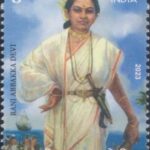
A commemorative postage stamp on Mahamandaleshwari Rani Chennabhairadevi (Queen of Pepper), longest ruling queen in Indian history, fought against Portuguese invasion :
Issued by India
Issued on Jul 24, 2025
Issued for : The Department of Posts is proud to release a commemorative postage stamp in honour of Queen Chennabhairadevi, the fearless queen who stood her ground against foreign invasions and led with wisdom, strength, and compassion. This stamp is a tribute to her unmatched legacy and a reminder of women’s powerful role in shaping our history.
Credits :
Stamp/FDC/Brochure/Cancellation Cachet : Sh. Anuj Kumar
Type : Stamp, Mint Condition
Colour : Multi Colour
Denomination : 500 Paise
Stamps Printed : 303650
Printing Process : Wet Offset
Printer : Security Printing Press, Hyderabad
Name : Chennabhairadevi
Born on 16th century at Bhatkal, Uttara Kannada district, Karnataka, India
Died on 17th century at Keladi, Sagara taluk, Karnataka, India
About :
- In the history of the entire Indian subcontinent, Queen Chennabhairadevi, titled Raina–Da Pimenta (Queen of Pepper), ruled for the longest period. A courageous woman from the Kannada land, she ruled for an exceptionally long time and faced historical adversities, making her the great queen of Gerusoppa, Karnataka.
- From 1552 to 1606, Queen Chennabhairadevi ruled the coastal and Malnad regions, stretching from Trasi in Karnataka to the Goa border and from the Western Sea to the highlands of Avinahalli. She was the ruler of the twin states of Haduvalli and Gerusoppa. Initially, she took over the administration of Haduvalli under the Vijayanagara emperors as Mahamandaleshwari. Later, the Vijayanagara emperors entrusted her with the administration of Gerusoppa, which was previously ruled by her maternal uncle. At that time, she was only eighteen years old. She received her early education at the Ghatikasthana of Haduvalli and trained in warfare in the coastal region and in naval combat in Kerala.
- Despite her kingdom being surrounded by enemies on multiple fronts, she neither feared nor hesitated. While the rulers of Keladi, Bilagi, and the Portuguese of Goa were hostile to her, the Honneya Kambali rulers, the Bhairarasas of Karkala, and the Zamorins of Kerala maintained friendly relations with her. She even made a treaty with the Sultan of Bijapur and maintained a harmonious relationship with the Vijayanagara emperors. She never initiated aggression, but never bowed to invaders. In 1558 and again in 1569–70, she defeated the Portuguese forces that invaded Honnavar. She kept the Keladi rulers in check and, by the end of 1558, even defeated them in a direct battle. Under her rule, her kingdom was prosperous, secure, and inclusive. People of various religions, castes, and professions lived together in harmony.
- She was skilled in commerce. Initially, black pepper was just a wild forest product, but she introduced it as a cultivated crop to the farmers of the Malnad and coastal regions. She established a system to export it in large quantities abroad. Despite politically opposing the Portuguese, she cleverly engaged in commercial ties with them, exporting rice, pepper, cardamom, cinnamon, jaggery, betel nuts, sandalwood, ginger, cloves, and ivory. Because of this, Dr Hannah Chapelle Wojciechowski opined that the Portuguese honoured her with the title Raina-Da Pimenta (The Pepper Queen).
- In the 1560s, when the Portuguese established the Inquisition Court in Goa and intensified forced conversions, they committed atrocities against non-Christian communities like the Saraswats, Kharvis, and fishermen, rendering them destitute and exiling them. Queen Chennabhairadevi provided shelter to such oppressed groups, utilised their professional skills to enhance her kingdom’s economy, and ensured they had a livelihood.
- After the fall of the Vijayanagara Empire in 1564, when it attempted a revival in Penukonda, Queen Chennabhairadevi provided resources for its resurgence. The Portuguese were secretly intimidated by her. Hence, historical records reveal a letter from the Portuguese king to the governor of Goa instructing him to deal with her with “humility, prudence, and diplomatic wisdom.”
- More than five centuries ago, she established a wealthy and stable kingdom through foreign trade and diplomatic expertise and ruled it for over half a century.
- Text : Based on information provided by the proponent.





One thought on “Rani Chennabhairadevi”
Very interesting. Came to know about her after visiting the Mirzan fort in Karwar .