M.S. Swaminathan
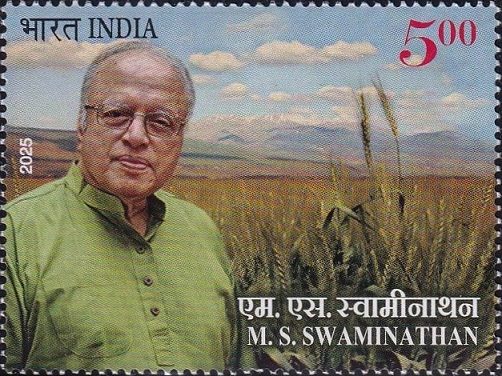
A commemorative postage stamp on the Birth Centenary of Mankombu Sambasivan Swaminathan, who transformed Indian agriculture and known for his role in making India a food-secure nation :
Issued by India
Issued on Aug 7, 2025
Issued for : The Department of Posts proudly releases a Commemorative Postage Stamp in honour of M.S. Swaminathan, celebrating his visionary contributions that transformed Indian agriculture and played a pivotal role in making India a food-secure nation.
Credits :
Stamp/FDC/Brochure/Cancellation Cachet : Ms. Gulistaan
Type : Stamp, Mint Condition
Colour : Multi Colour
Denomination : 500 Paise
Stamps Printed : 303225
Printing Process : Wet Offset
Printer : Security Printing Press, Hyderabad
Name : Monkombu Sambasivan Swaminathan
Born on 7 Aug, 1925 at Thanjavur, Tamil Nadu, India
Died on 28 Sep, 2023 at Chennai, India
About :
- Prof. Monkombu Sambasivan Swaminathan is globally revered as the father of India’s Green Revolution. Born in Tamil Nadu, India, on August 7, 1925, Swaminathan was educated at Travancore and Madras Universities. He earned his Ph.D. in Genetics from the University of Cambridge in 1952 and received 85 honorary doctorates from institutions across continents. His scientific legacy is grounded in his work at the Indian Agricultural Research Institute (1954-1972), where he initiated the dwarf wheat breeding programme and spearheaded efforts to raise yields through genetic innovation and crop improvement.
- From 1972 to 1979, he served as Director General of the Indian Council of Agricultural Research (ICAR), during which he also designed and initiated the Agricultural Research Services (ARS) to enable lifelong specialisation for scientists. ARS helped attract and retain brilliant young scientists in the ICAR system. From 1972 to 1979, he concurrently served as Secretary of the Department of Agricultural Research and Education. From 1979 to 1980, he was Principal Secretary of the Ministry of Agriculture and Irrigation. He managed the 1979 drought as Secretary to the Government of India in the Ministry of Agriculture. Between 1980 and 1982, he served as a Member in charge of Agriculture and Rural Development in India’s Planning Commission. From 1981 to 1985, he was the Independent Chairman of the FAO Council. From 1982 to 1985, he was founder-chairman of the Society for the Promotion of Wasteland Development (SPWD), a professional NGO committed to ecological restoration. He also founded the International Council for Research on Agro-Forestry (ICRAF) and served as its Chairman (1977-1982).
- From April 1982 to January 1988, he served as Director General of the International Rice Research Institute (IRRI). At IRRI, he prioritised sustainable rice production and intra-generational and inter-generational equity in the research agenda.
- Between 1984 and 1990, he served as President of the International Union for the Conservation of Nature and Natural Resources (IUCN). From 1989 to 1996, he was President of the World Wide Fund for Nature (India). From 2002 to 2007, he served as President of the Pugwash Conferences on Science and World Affairs.
- In addition to being a Fellow of the Indian National Science Academy and the Royal Society of London, Dr. M.S. Swaminathan worked in collaboration with scientists and policymakers on a wide range of problems in basic and applied plant genetics and agricultural research and development. He also helped develop a transparent and implementable method of recognising and rewarding the intellectual property contributions of tribal and rural families in the conservation and selection of plant genetic resources.
- He has published several hundred papers in international journals and several books, including “Building a National Food Security System” (Indian Environmental Society, 1981) and “Science and Integrated Rural Development” (Concept Publishing Company, New Delhi, 1982).
- He chaired several national and international committees of experts, including the Indian Expert Group on Programmes for the Alleviation of Poverty, Eradication of Leprosy and Blindness, the eco-development of Goa, the Himalayas and Western Ghats, and the preparation of a draft National Population Policy and a draft Biodiversity Act.
- He also served as Chairman of the Advisory Panel on Food Security, Agriculture, Forestry and Environment to the World Commission on Environment and Development (WCED).
- Among his many distinguished awards are the Ramon Magsaysay Award for Community Leadership (1971), the first award for serving the cause of women in development (1985), Padma Shri (1967), Padma Bhushan (1972), and Padma Vibhushan (1989). In 1986, he received the Albert Einstein World Award of Science. On October 6, 1987, he became the first laureate of the World Food Prize, regarded widely as the equivalent of a Nobel Prize in Agriculture. UNESCO designated Dr. M.S. Swaminathan in 1996 as UNESCO-Cousteau Professor in Ecotechnology for Asia.
- During 2004-06, Dr. M.S. Swaminathan served as Chairman of the National Commission on Farmers (NCF). On the basis of the report of the NCF, the Government of India announced a National Policy for Farmers in 2007. He was a Member of the Parliament of India (Rajya Sabha), from 2007-13. During 2010-13, he chaired the High Level Panel of Experts (HLPE) for the World Committee on Food Security (CFS).
- Dr. M.S. Swaminathan passed away on September 28, 2023, in Chennai, leaving behind a monumental legacy of scientific innovation that advanced global food security and championed sustainable agriculture.
- Text : Reference from the content provided by Proponent.