

A commemorative postage stamp on First Indian Elected Speaker, Vithalbhai Patel, elder brother of Sardar Vallabhbhai Patel :
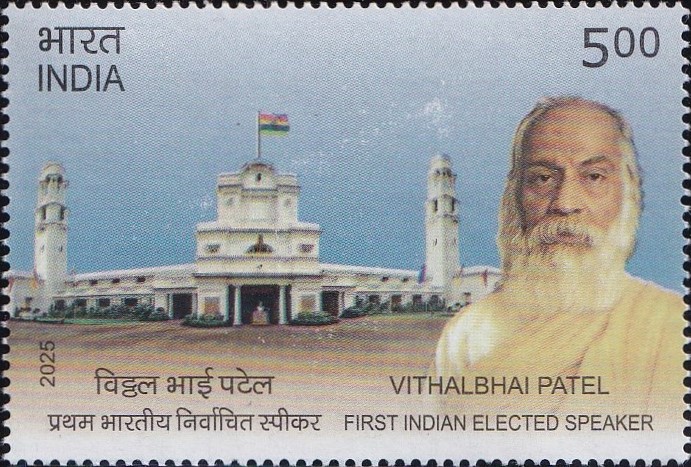 Issued by India
Issued on Aug 24, 2025
Issued for : The Department of Posts is proud to release commemorative postage stamp honouring Vithalbhai Patel. This stamp pays tribute to his sacrifices, strategic brilliance, and unwavering pursuit of freedom, cementing his place as a pivotal figure in India’s journey to independence.
Credits :
Stamp/FDC/Brochure/Cancellation Cachet : Shri Sankha Samanta
Type : Stamp, Mint Condition
Colour : Multi Colour
Denomination : 500 Paise
Stamps Printed : 305910
Printing Process : Wet Offset
Printer : Security Printing Press, Hyderabad
Name : Vithalbhai Patel
Born on 27 Sep, 1873 at Nadiad, Gujarat, India
Died on 1933
About :
- Vithalbhai Patel was born on 27 September 1873 in Nadiad, Gujarat. Raised in Karamsad, he pursued self-education and worked as a junior lawyer in Godhra and Borsad before attending the Middle Temple in London to study law. His younger brother, Vallabhbhai, sacrificed his opportunity to study abroad to fund Vithalbhai’s education, reflecting their deep fraternal bond.
- Vithalbhai’s political career began in 1912 with his election to the Bombay Legislative Council, where he championed bills on municipal governance, town planning, and education. His 1917 proposal to extend primary education to municipal districts outside Bombay earned widespread acclaim. Elected to the Imperial Legislative Council in 1918, he resigned in 1920 to support Gandhi’s Non-Cooperation Movement. Disillusioned by Gandhi’s suspension of the movement after the Chauri Chaura incident (1922), Vithalbhai co-founded the Swaraj Party to disrupt British governance through legislative participation.
- His legislative experience, nationalist credentials, and Swaraj Party leadership made him a natural candidate for the Speaker’s role. In March 1925, following the retirement of Sir Frederick Whyte, the Assembly’s first British President, Vithalbhai was elected Speaker, defeating T. Rangachariar by a narrow margin of two votes. His unanimous re-election in 1927 underscored his growing stature.
- As Speaker, Vithalbhai’s role was multifaceted, encompassing ceremonial duties, procedural oversight, and political leadership. Vithalbhai’s tenure (1925–1930) was transformative, marked by procedural innovations, the defence of legislative independence, and the navigation of political tensions.
- Vithalbhai established well-defined rules, regulations, and practices for the Assembly’s functioning, many of which became enduring parliamentary traditions. Before his tenure, the Assembly’s procedures were ad-hoc, reflecting its nascent status and British dominance. Drawing inspiration from British parliamentary practices, Vithalbhai systematised these processes while adapting them to Indian contexts.
- He established the convention that the Speaker remain neutral in debates, intervening only to maintain order or cast a deciding vote, ensuring impartiality. His 1927 visit to Britain and Ireland to study parliamentary procedures informed his reforms, aligning the Assembly with global democratic standards. These reforms professionalised the Assembly, transforming it into a quasi-parliamentary body.
- In 1928, Vithalbhai established a separate office for the Assembly, independent of the Government of India’s administration. This bold reform symbolised Indian legislators’ demand for self-governance and set a precedent for future Indian parliaments.
- Vithalbhai was a staunch defender of legislators’ rights, particularly their freedom of speech and immunity from government reprisals. He upheld members’ rights to raise contentious issues, such as British repression during nationalist protests, and ruled against government attempts to censor debates.
- On 8 April 1929, Bhagat Singh and Batukeshwar Dutt threw non-lethal bombs in the Assembly to protest colonial laws. Vithalbhai maintained composure, adjourning the session calmly. While condemning the act, he expressed sympathy for the revolutionaries’ motives, reflecting his nationalist leanings.
- Traditionally, the Speaker vacated the chair during the Viceroy’s address, sitting among members as a subordinate. Vithalbhai broke this practice, remaining in the chair to assert the Speaker’s supremacy, symbolising legislative dignity.
- His interactions with Viceroy Lord Irwin were marked by tact and firmness. In 1927, during Gujarat’s flood crisis, he persuaded Irwin to visit affected areas, leveraging his position for public welfare.
- As a Swaraj Party leader, Vithalbhai balanced his nationalist ideology with the Speaker’s requirement for impartiality. Vithalbhai ensured fair debates without overtly favouring his party. His wit and mastery of constitutional law earned respect from British officials, even as he challenged their authority.
- The Assembly’s inability to enact meaningful legislation, due to the Viceroy’s veto power, frustrated Vithalbhai’s ambitions. British officials viewed Vithalbhai’s reforms with suspicion, fearing they would embolden nationalists. His push for an independent Assembly office faced bureaucratic resistance. His rulings and speeches inspired legislators to challenge colonial authority.
- Vithalbhai’s impartiality was evident in his refusal to fund the Swaraj Party from his salary, instead donating to national causes through Gandhi to avoid accusations of bias. His relationship with Viceroy Irwin facilitated key initiatives, including the idea of a Round Table Conference.
- Vithalbhai’s deteriorating health, exacerbated by his demanding role, led to medical treatment in Europe and his death in 1933. Patel’s legacy endures through institutions like Gujarat’s Legislative Assembly building and parliamentary norms that shape India’s democracy.
- Text : Referenced from content provided by the proponent.
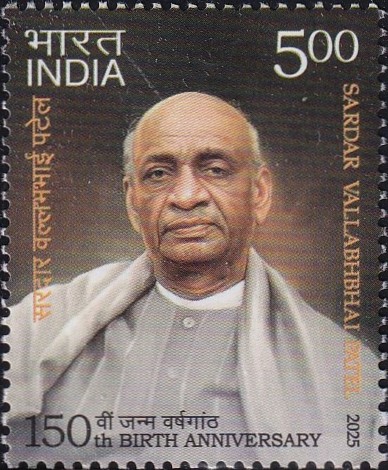
![665 Vallabhbhai Patel [India Stamp 1975]](https://istampgallery.com/wp-content/uploads/2015/02/665-Vallabhbhai-Patel-India-Stamp-1975.jpg "Sardar Vallabhbhai Patel 1975")
![Sardar Vallabhbhai Patel - National Unity Day [India Stamp 2016]](https://istampgallery.com/wp-content/uploads/2017/03/Sardar-Vallabhbhai-Patel-National-Unity-Day-India-Stamp-2016.jpg "National Unity Day – Salute to the Unifier of India")
![588 Vithalbhai Patel [India Stamp 1973]](https://istampgallery.com/wp-content/uploads/2015/05/588-Vithalbhai-Patel-India-Stamp-1973.jpg "Vithalbhai Patel")