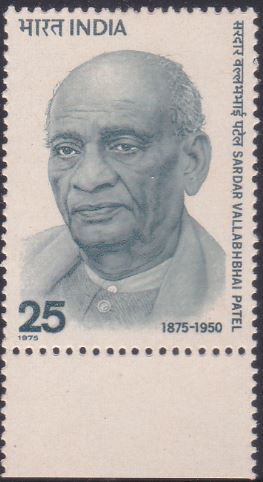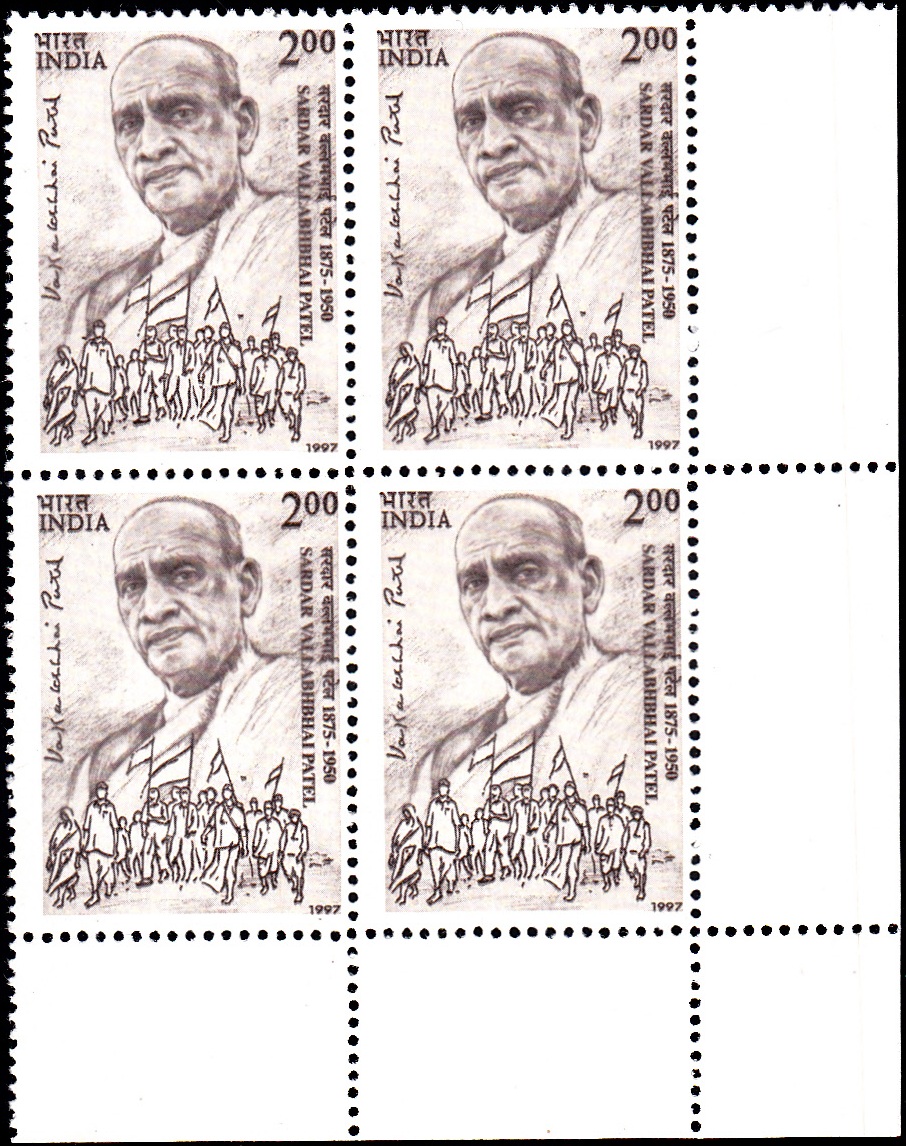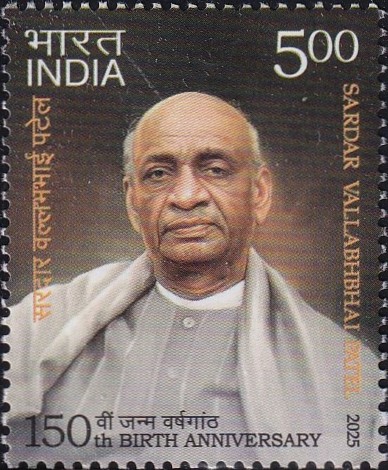
Sardar Vallabhbhai Patel 2025
A commemorative postage stamp on the 150th Birth Anniversary of Sardar Vallabhbhai Patel, first Deputy Prime Minister and Home Minister of India :
Issued by India
Issued on Oct 30, 2025
Issued for : India Post is proud to release a commemorative stamp on the 150th Birth Anniversary of Sardar Vallabhbhai Patel, honouring his unmatched contributions to India’s unity and nation-building. This special issue stands as a tribute to the Iron Man of India, whose legacy continues to inspire generations. Through this stamp, India Post not only celebrates a national icon but also reaffirms its commitment to preserving and promoting the rich heritage and history of our nation.
Credits :
Stamp/FDC/Brochure/Cancellation Cachet : Sh. Suresh Kumar
Type : Stamp, Mint Condition
Colour : Multi Colour
Denomination : 500 Paise
Stamps Printed : 202800
Printing Process : Wet Offset
Printer : Security Printing Press, Hyderabad
Name : Vallabhbhai Jhaverbhai Patel
Born on 31 Oct, 1875 at Nadiad, Gujarat, India
Died on 15 Dec, 1950 at Mumbai, India
About :
- Sardar Vallabhbhai Patel, born on October 31, 1875, in Nadiad, Gujarat, was a pivotal figure in India’s struggle for independence and the country’s subsequent integration. Known as the “Iron Man of India,” Patel’s tenacity, leadership and vision played a crucial role in unifying a fragmented nation post-colonial rule.
- Patel’s political journey began in earnest during the Kheda Satyagraha of 1918, where he mobilised farmers against oppressive taxation during a famine. His successful leadership earned him respect and recognition among the masses, and he emerged as a key figure in the Indian National Congress.
- In the 1920s and 1930s, Patel worked closely with Mahatma Gandhi, participating in various movements such as the Non-Cooperation Movement and the Civil Disobedience Movement. He became known for his pragmatic approach, often balancing the ideals of non-violence with the harsh realities of colonial rule.
- Patel’s contributions to India’s independence were substantial. His organisational skills were instrumental in establishing the Indian National Congress as a formidable political force. As a leader, he worked tirelessly to unite different factions within the Congress and forge alliances with various groups.
- One of Patel’s significant achievements was the Bardoli Satyagraha of 1928, where he successfully led farmers in a non-violent resistance against increased land revenue assessments. His leadership in this movement solidified his reputation as a champion of the agrarian community and demonstrated his ability to galvanise support among ordinary citizens.
- In 1942, Patel was imprisoned during the Quit India Movement, where he advocated for complete independence from British rule. His unwavering commitment to the cause of freedom made him one of the key architects of India’s liberation.
- After India gained independence on August 15, 1947, Patel faced the monumental task of unifying over 500 princely states into a single nation. His vision was clear: a united India was essential for stability and progress. As the first Deputy Prime Minister and Minister of Home Affairs, Patel employed a combination of diplomacy and firmness to persuade reluctant rulers to accede to India.
- His most notable achievement was the integration of states like Hyderabad and Jammu & Kashmir. Patel’s strategy often involved negotiations, but he was not afraid to use military action when necessary, exemplified by the police action in Hyderabad. His efforts culminated in the formation of a cohesive and united India, ensuring that the diverse states would coexist under a common national framework.
- Patel also championed social reforms, advocating for the upliftment of women and marginalised communities. He understood that a nation could only thrive if its citizens enjoyed equal rights and opportunities. His initiatives in education and rural development sought to empower the underprivileged and promote national integration.
- Sardar Vallabhbhai Patel passed away on December 15, 1950, leaving behind a legacy of unity and resilience. His contributions to India’s independence and nation-building have made him a revered figure in Indian history. In recognition of his efforts, Patel was posthumously awarded the title “Sardar,” meaning leader or chief, which symbolises his leadership qualities and his role as a unifier.
- Sardar Vallabhbhai Patel remains an enduring symbol of unity, determination, and visionary leadership. His life’s work not only contributed to India’s independence but also laid the foundations for a unified and progressive nation. As India continues to navigate the complexities of a diverse society, Patel’s principles of tolerance, unity, and resilience are more relevant than ever. His legacy as the Iron Man of India will forever inspire those who seek to create a better, more integrated world.
- Text : Based on information provided by the proponent.