


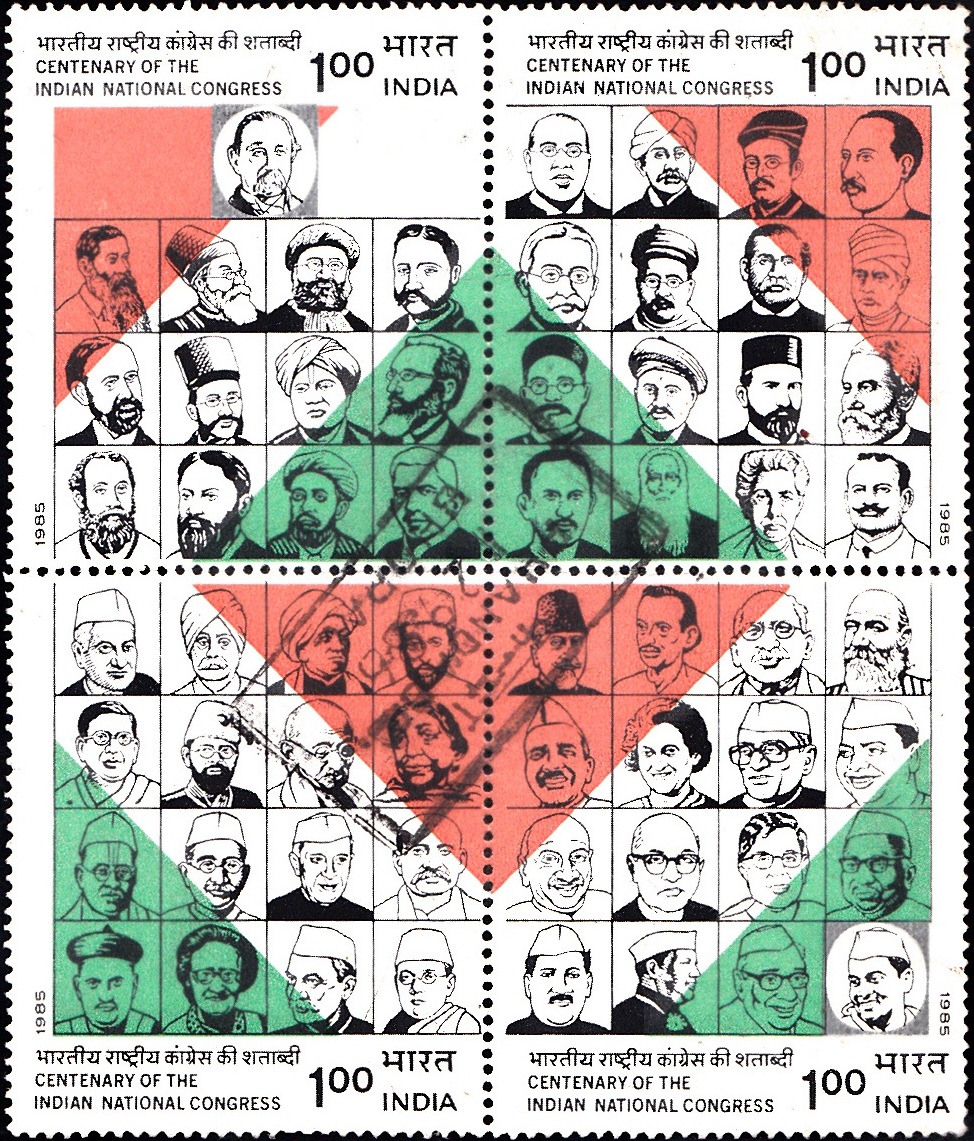
Complete Set of 4 nos of postage stamps on the Centenary of the Indian National Congress, an Indian political party :
 Issued by India
Issued on Dec 28, 1985
Issued for : The Department of Posts is happy to bring out a set of commemorative postage stamps on the Centenary of the Indian National Congress.
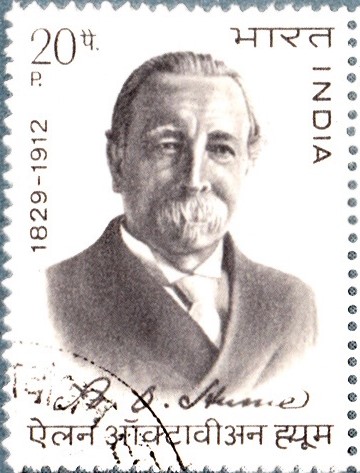
Description of Designs : The se-tenant set prepared by India Security Press, Nashik Road, based on a design by C.R. Pakrashi, presents a composite picture, depicting the portraits of A.O. Hume & 60 Congress Presidents starting from W.C. Bonnerjee, to the present President, Shri Rajiv Gandhi. The First Day Cover has been designed by C.R. Pakrashi. The cancellation has been designed by Nenu Bagga.
Type : Se–tenant Block of 4 Stamps, Postal Used
Colour : Multi colour
Denomination : 100 Paise each
Overall size : 9.66 x 8.12 cms.
Printing size : 9.66 x 8.12 cms.
Perforation : 14 x 14
Paper : Unwatermarked adhesive stamp paper
Number printed : 15,00,000 each
Number per issue sheet : 12
Printing process : Photogravure
Printed at : India Security Press
About :
- The Indian National Congress was founded in 1885 and in the same year, the first session was held in Bombay under the Presidentship of Shri W.C. Bonnerjee. The illustrious sons of India like Dadabai Naoroji, Surendra Nath Bannerjee and Madan Mohan Malaviya laid the foundation of this organisation.
- From the very beginning, the aim of the Congress was to establish Parliamentary institutions in the country. Renowned Constitutional experts like Dadabai Naoroji, Surender Nath Bannerjee and Gopal Krishan Gokhale, worked untiringly for setting up Parliamentary system of Government and for the growth of a secular, multilingual and multi-religious nationalism. Bal Gangadhar Tilak, Aurobindo Ghosh, Lajpat Rai and Bipin Chandra Paul were the first to adopt the posture of radical nationalism and invoked their countrymen to adopt a more dynamic plan of action. Lok Manya Tilak was the first to declare “Swaraj is my birthright”. In 1929, Jawaharlal Nehru presided over the Lahore session of the Congress. In this Session, the Congress declared complete freedom as its ultimate goal. During the Civil Disobedience Movement in 1930-31 and 1931-32, the Indians undertook agitations on the appeal from Congress and these movements shook the foundations of the foreign rule in India.
- The Father of the Nation, Mahatma Gandhi could feel the pulse of the nation. He asserted that to achieve freedom, it was essential to create political awakening among the masses and train them for a struggle through non–violence against the foreign domination. Thus, non-violence became the basic creed of the Congress. The historic Karachi Session of Congress in 1931 was held under the Chairmanship of Vallabh Bhai Patel in which the famous resolution of fundamental rights was adopted.
- In the Lucknow Session 1936, Nehru formulated the foreign policy for the country based on working for peace and freedom, support for freedom struggle elsewhere and raising our voice against colonialism.
- In the historic meeting of All India Congress Committee, held in Bombay in 1942, presided over by Maulana Abul Kalam Azad, Mahatma Gandhi gave the slogan ‘Do or Die’ and people of India stood as one force to fight the British Rule. Their struggle bore fruit in 1947 and India attained the long cherished independence.
- Smt. Indira Gandhi as Congress President in 1959 and from 1978 to 1984 worked for the cherished goal of a socialistic society. Decisions of her Government like Nationalisation of Banks and insurance companies, abolition of privy purses etc. were all aimed at removing economic disparity and increasing social control over the means of production and distribution. Great leaders have nourished and contributed to its growth and maturity.

![1106 Sea Pictures, by Edward Elgar, Waves, Wing [England Stamp 1985]](https://istampgallery.com/wp-content/uploads/2015/09/1106-Sea-Pictures-by-Edward-Elgar-Waves-Wing-England-Stamp-1985.jpg "British Composers")
22 Comments
Mohammed Althaf
December 28, 1985Please advise the list of personalities which can see on the INC centenary stamp.
R. Sankar - iStampGallery
December 28, 1985[…] contributions to the country, as a Member of the Constituent Assembly, as a leader of the Congress Party and as the Chief Minister of the State of Kerala, were of lasting significance, as also his […]
Virchand Raghavji Gandhi - iStampGallery
December 28, 1985[…] women to the U.S.A. for studies. He visited England, France and Germany. In 1895, he attended The Indian National Congress held in Pune as the representative from Mumbai. In 1899 he attended the International Conference of […]
Baldev Ramji Mirdha - iStampGallery
December 28, 1985[…] Sabha and enlarged the ambit of his activities. He was working in cooperation with Lok Parishad and Congress leaders like Jai Narain Vyas. It was after consultations with Jawahar Lal Nehru and Govind Ballabh […]
Jayaprakash Narayan 2001 - iStampGallery
December 28, 1985[…] to a movement of “total revolution“, which culminated in establishment of the first non-Congress government of the country in […]
Satish Chandra Samanta - iStampGallery
December 28, 1985[…] Chandra Samanta started his public life through the activities organised by the Indian National Congress in his locality. He went on to become the President of the Tamluk Congress Committee and remained a […]
Chaudhary Devi Lal - iStampGallery
December 28, 1985[…] only fifteen when he left studies at the call of Mahatma Gandhi and became an active member of the Indian National Congress. He participated in the Civil Disobedience and Quit India Movements and was imprisoned several […]
August Kranti : Ballia - iStampGallery
December 28, 1985[…] Indian National Congress at its Bombay session (August 1942) passed the famous Quit India resolution, calling for a mass […]
Chaudhary Brahm Parkash - iStampGallery
December 28, 1985[…] from the village Shakarpur in Delhi, he started his public life with the local Congress Committee in 1936, at a time when the freedom struggle was moving towards its crescendo. He was […]
India on 1942 Quit India Movement in 1992 - iStampGallery
December 28, 1985[…] he delivered just after the passing of the historic ‘Quit India’ resolution by the All-India Congress Committee on 8th August, 1942 at Bombay ushered in a new phase in the glorious struggle for […]
Gopinath Bordoloi - iStampGallery
December 28, 1985[…] the Congress Party leader in the Provincial Assembly in 1937, he brought the struggle also into legislature. Even […]
Balwantrai Mehta - iStampGallery
December 28, 1985[…] an M.P. in the general elections of 1952 and 1957 from Gohilwad. He was also the Secretary of the Congress Parliamentary Party and the Chairman of the Estimates Committee. The name of Shri Balwantrai Mehta […]
Burgula Ramakrishna Rao - iStampGallery
December 28, 1985[…] Swami Ramanand Thirtha and other leaders. He was one of the founder members of the Hyderabad State Congress. He presided over the third Andhra Mahasabha conference at Devarkonda in 1931 and was responsible […]
Swami Sahajanand Saraswati - iStampGallery
December 28, 1985[…] and an Ashram for political and Sanskrit teaching at Bihata. As a recognition of his work for the Congress, he was first elected a member of the UPCC and then of the BPCC and the […]
Bindheshwari Prasad Mandal - iStampGallery
December 28, 1985[…] He worked as a Honorary Magistrate during 1945-51. Though his political career started with the Indian National Congress, he was soon attracted towards the ‘Socialist’ stream of thought, and joined the Samyukta […]
Sardar Vallabhbhai Patel 2025 - iStampGallery
December 28, 1985[…] Patel’s political journey began in earnest during the Kheda Satyagraha of 1918, where he mobilised farmers against oppressive taxation during a famine. His successful leadership earned him respect and recognition among the masses, and he emerged as a key figure in the Indian National Congress. […]
Karpoori Thakur 2024 - iStampGallery
December 28, 1985[…] His father was from the ‘Nai’ (barber) community in Bihar. Karpoori Thakur was the first Non-Congress CM of Bihar in 1971. He became CM Twice, 1970-1971 and 1977 and became Deputy CM in 1967. He was […]
Rao Birender Singh - iStampGallery
December 28, 1985[…] After general Election of 1984, Rao Birender Singh joined as Union Agriculture and Food Minister under the leadership of the then Prime Minister Shri Rajiv Gandhi. Rao Birender Singh resigned on 25th September 1985 from the Cabinet as he was against Rajiv Longowal Agreement, on the Table of the House itself. In the history of independent India it was the first time when any cabinet minister has given his resignation letter in public interest in the House itself. He later resigned from Parliament and the Congress Party. […]
Baba Raghav Das - iStampGallery
December 28, 1985[…] joined the Indian National Congress in 1920, and made his headquarters in the Gorakhpur District of Uttar Pradesh where he worked for […]
Vande Mataram: 150 Years of National Inspiration - iStampGallery
December 28, 1985[…] popular among the masses after Gurudev Rabindranath Tagore gave it voice at the 1896 session of the Indian National Congress. The song became a rallying cry of the Swadeshi Movement following the partition of Bengal in 1905, […]
National Unity Day: Sardar Patel's Legacy of Unity - iStampGallery
December 28, 1985[…] He was elected as Ahmedabad’s Municipal President in 1922, 1924 and 1927. He was elected as Congress President in 1931. He played key roles in organising peasant’s movements in Kheda, Borsad and […]
Sardar Vallabhbhai Patel: Statesman of Independent of India - iStampGallery
December 28, 1985[…] Chairman of the Congress Parliamentary Sub-Committee in 1936 and ably guided the functioning of the Congress ministries in various provinces. An active participant in the Individual Satyagraha in 1940, he […]