

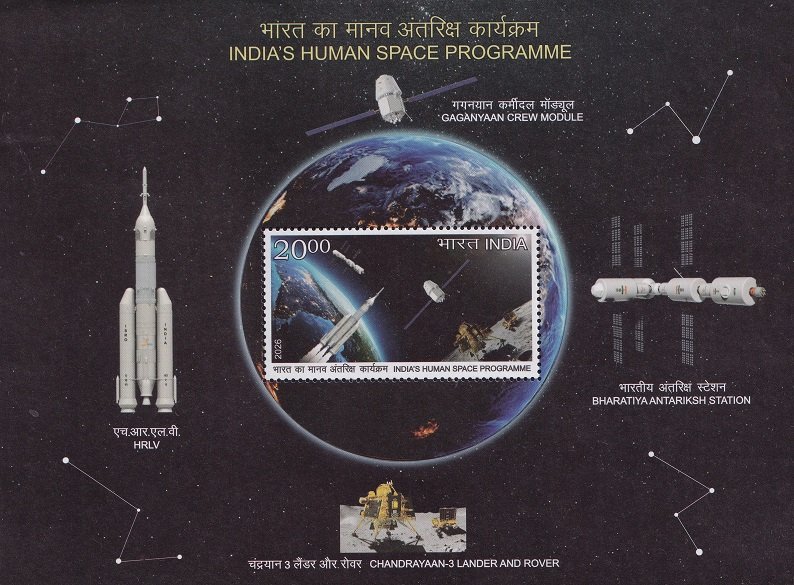

Complete set of 2 nos. of souvenir sheets consisting of 1 no. of postage stamp each on the Indian Human Spaceflight Programme by ISRO (Indian Space Research Organisation) as of 2026 :
 Issued by India
Issued on Apr 12, 2026
Issued for : The Department of Posts is pleased to issue two Souvenir Sheets on India’s Human Space Programme, and celebrates India’s transition from a participant to a leader in space technology and exploration.
Credits :
1) Design of Stamp, Souvenir Sheet, FDC, Brochure, Cancellation Cachet : Sh. Suresh Kumar
2) Images and text – ISRO (Indian Space Research Organization) and Group captain Shubhanshu Shukla.
3) Patch Design – Sh. Manish Tripathi
Type : Souvenir Sheet, Mint Condition
Colour : Multi Colour
Stamp Denomination : 2000 Paise, 2000 Paise
Souvenir Sheets Denomination : 2000 Paise
Souvenir Sheets Printed : 111000 (2)
Printing Process : Wet Offset
Printer : Security Printing Press, Hyderabad
About :
- Indian Space Research Organisation (ISRO), a major arm of the Department of Space (DoS), Government of India, has spent over five decades advancing space technology for national development and global collaboration. India’s space journey began in 1962 under Vikram A. Sarabhai with the formation of INCOSPAR, later evolving into ISRO in 1969. Since then, ISRO has developed reliable launch vehicles such as PSLV, GSLV, LVM-3, and SSLV, while also designing satellites for communication, broadcasting, meteorology, navigation, disaster management, and resource monitoring in partnership with academia and industry.
- ISRO has also built a strong global presence through international collaborations and commercial launch services via NewSpace India Limited. Notable milestones include missions like Chandrayaan–3, Aditya-L1, and the joint mission of ISRO-NASA i.e., NISAR. Looking ahead, ISRO is preparing for its first human spaceflight program, Gaganyaan, along with ambitious future projects such as a Venus orbiter, Chandrayaan-4 and 5, and the development of an indigenous space station, reinforcing its role as a key player in the global space sector.
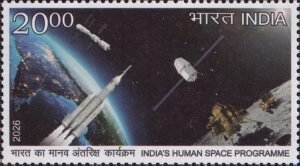
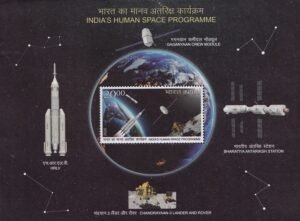
- One of the Souvenir Sheet depicts India’s advancing space capabilities against Earth, symbolizing a unified future vision. At its center, the Gaganyaan crew module reflects India’s human spaceflight capabilities, while the Bharatiya Antariksh Station signifies India’s transition into an elite, indigenous space-faring power, aiming to establish a functional, modular space station in Low Earth Orbit by 2035. The Chandrayaan-3 lander and rover highlight successful lunar exploration. Complementing these is the Human Rated Launch Vehicle (HRLV), designed to carry 2–3 astronauts to 300–400 km orbit. Together, they showcase India’s journey from lunar missions to human spaceflight and future orbital infrastructure.
- India has also achieved a historic milestone with Group Captain Shubhanshu Shukla becoming the first Indian astronaut to visit the International Space Station through the Axiom–04 mission. The Axiom-04 mission has successfully concluded with the return of ISRO Gaganyatri Shubhanshu Shukla, marking a proud moment both for ISRO and India as he returned after a historic 18-day scientific mission aboard the International Space Station (ISS).
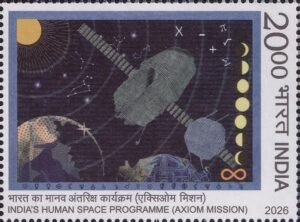
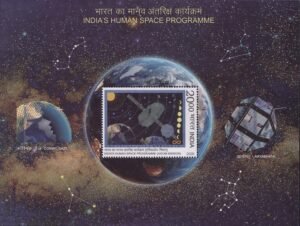
- The Axiom-04 mission patch worn by Group Captain Subhanshu Shukla has been used in the second Souvenir Sheet design which presents a cohesive narrative of India’s space journey. The patch weaves together symbols that reflect India’s journey from ancient knowledge to modern space exploration. At its center is the Earth, representing shared origins, alongside an astronaut gazing toward the stars, symbolizing human curiosity. The Gaganyaan capsule highlights India’s human spaceflight ambitions, while the Sun above signifies life and energy in Indian culture, surrounded by astronomical motifs honoring early cosmic understanding. Tessellated lines connect past, present, and future, emphasizing continuity, and mathematical symbols underscore the importance of science and logic. The Moon’s phases celebrate India’s lunar achievements, while the Aryabhatta satellite marks the nation’s first step into space and its 50-year milestone. The Jantar Mantar of Jaipur reflects centuries-old astronomical heritage, and the central infinity symbol represents endless exploration and learning. The entire patch takes the shape of a stamp, signifying India’s new and permanent address in space – a bold declaration that our journey among the stars has truly begun.
- Text : ISRO (Indian Space Research Organization) and Group captain Shubhanshu Shukla.

![392 Indian Lion [India Stamp 1963]](https://istampgallery.com/wp-content/uploads/2015/06/392-Indian-Lion-India-Stamp-1963.jpg "India Wild Life Series 1963")