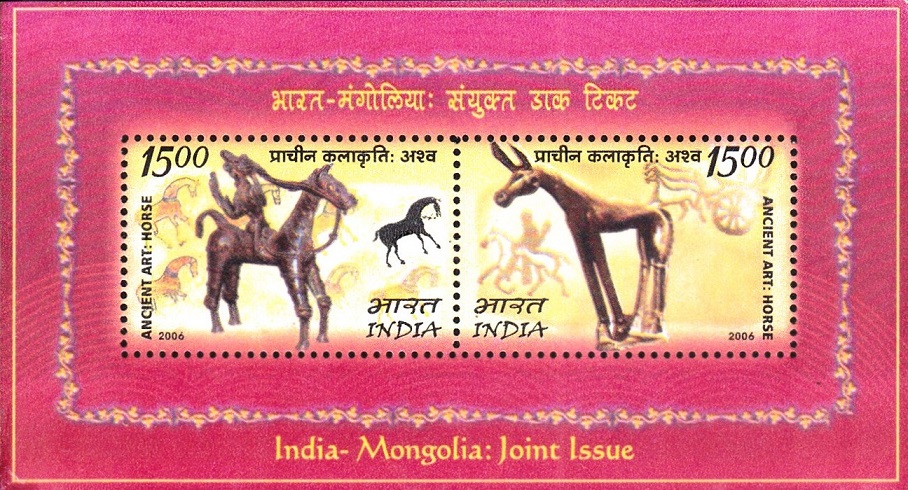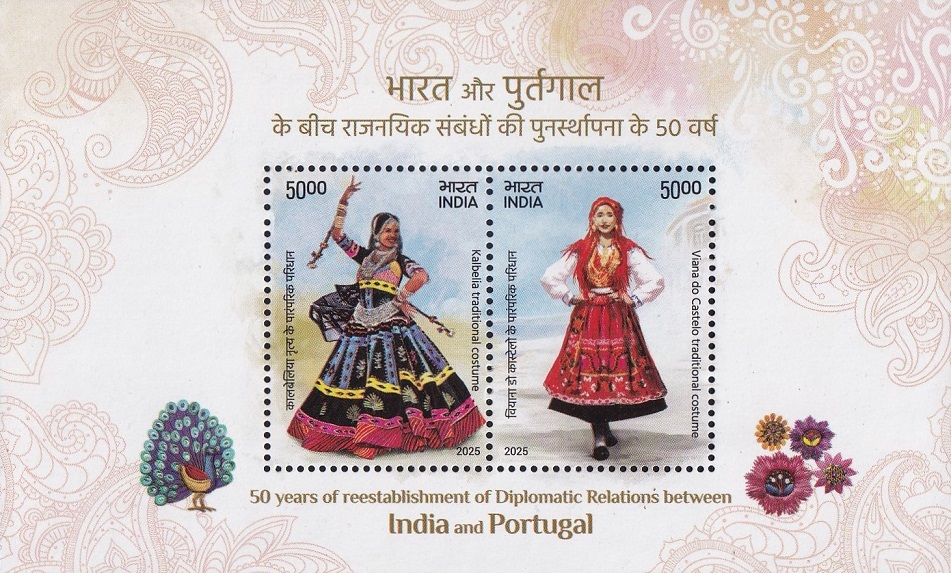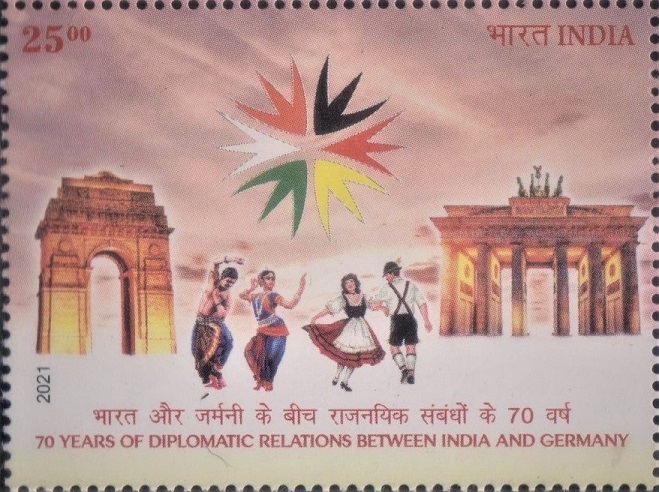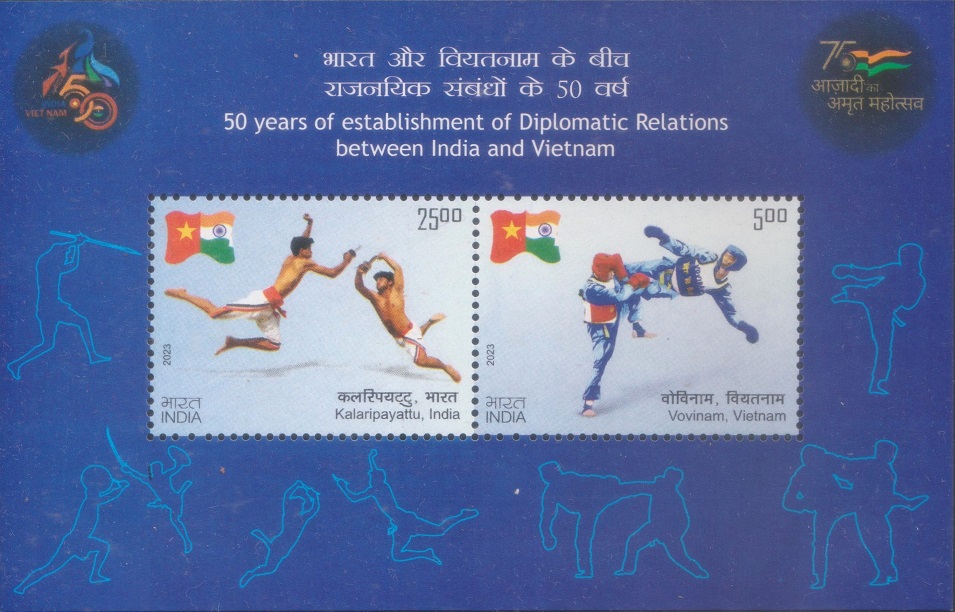


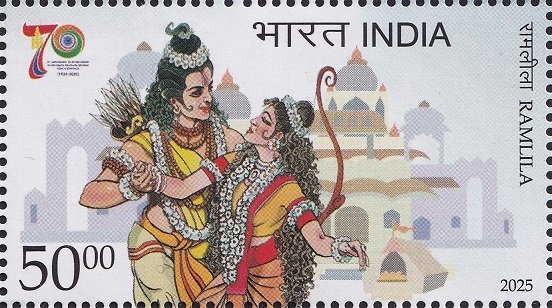
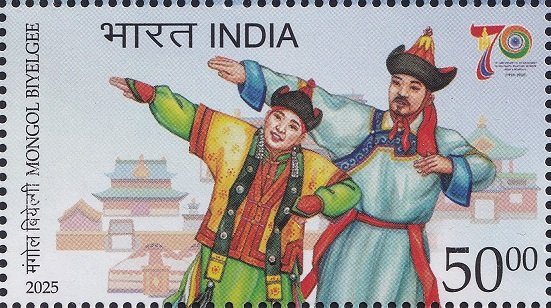
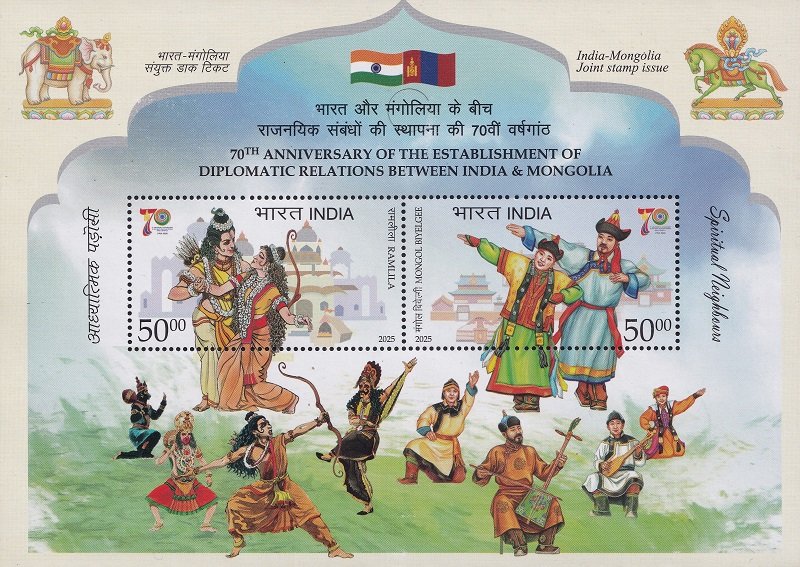
Complete Set of 2 nos of commemorative postage stamps on the 70th Anniversary of the establishment of Diplomatic Relations between India and Mongolia :
 Issued by India
Issued on Oct 14, 2025
Issued for : India Post is proudly releases joint postage stamp to commemorate 70th Anniversary of the establishment of Diplomatic Relations between India and Mongolia.
Credits :
Stamp/FDC/Brochure/Cancellation Cachet : Shri Suresh Kumar
Type : Souvenir Sheet, Mint Condition
Colour : Multi Colour
Denomination : 5000 & 5000 Paise
Souvenir Sheet Price : 10000 Paise
Souvenir Sheets Printed : 113100
Printing Process : Wet Offset
Printer : Security Printing Press, Hyderabad
About :
- For most Mongolians, India is a “spiritual neighbour,” a declared ‘third neighbour, a ‘strategic partner’, and a centre for pilgrimage. Lately, the 4 Ds Dharma, Democracy, Development Partnership, and Digital Development Cooperation have become pillars of the Mongolian relationship. Historically, India and Mongolia have interacted through the shared heritage of Buddhism.
- It is believed that some tribes from the Kangra kingdom migrated to Mongolian territory 4300 years ago with Mangaldev, son of the Kangra king, and the majority of them returned to India after staying there for about 2000 years, though there is no historical evidence yet to prove this. In 1924, Mongolian PM A. Amar proposed in his book that Mongolian ancestors could have come from the Himalayas.
- The ‘Ganga Nuur’ lake is believed to have derived its name from the Ganga River in India. As per the popular legends some Mongolian Lamas brought water from Ganga and poured it into the lake in Sukhbaatar Province and named it so. As for Buddhism, it appears to have traversed to Mongolian steppes through Tibet and the Himalayan region. During the Hunnu State and Great Mongol Empire periods, Buddhist monks and Indian traders visited Mongolia. In 552 BC, a Lama Narendrayash from the State of Udayana (Northern India) with some others visited Nirun state. Since India is regarded as the land of Buddha, Lamas and students from Mongolia used to travel to Nalanda, once the largest residential University in India, to study Buddhism.
- These accounts confirm that both India and Mongolia were in close direct contact especially during 5-7 centuries AD and it seems that Buddhism in Mongolia accelerated the process of further spread of Indian culture in Mongolia. The intellectual development of Mongolia is ostensibly influenced by the Mahayana school of Buddhism, its philosophy and the philosophical treaties of Nagarjuna used in simplified expression and terminology.
- Mongolian Buddhism is predominantly the Yellow Hat sect of Buddhism practiced in Tibet and China, but over the centuries, it has evolved into its own version, having incorporated the pre-Buddhist religion of ‘Tengarism’ as well as ‘Shamanistic’ influences.
- Over the last few decades, India–Mongolia relations have been on upward trajectory with several high-level visits further consolidating the relations. Late Ambassador 19th Bakula Rimpoche, during his 10 years’ tenure in Mongolia from 1990-2000, contributed immensely to consolidating this legacy of Buddhist connection with India and was instrumental in reviving hundreds of Buddhist monasteries in Mongolia and setting up of revered Pethub Monastery in Ulaanbaatar city. The relations have deepened, intensified and consolidated our shared heritage of Buddhism with Mongolia.
- The diplomatic relations with Mongolia were established on 24th December 1955 and in January 1956, the first Mongolian Ambassador was posted to New Delhi. However, the Resident Mission of India in Ulaanbaatar was opened on 22 February 1971 and before that Indian Ambassador in Moscow (T.N. Kaul) was concurrently accredited. In 2020, the Embassy of India marked the 65th anniversary of India–Mongolia diplomatic relations during which a special commemorative stamp by Mongol Post on the 65th anniversary was released in Dec 2020 by Hon. External Affairs Minister of India.
- Text : Referenced from content provided by Ministry of External Affairs.