

Perumbidugu Mutharaiyar II, also known as Samrat Suvaran Maran, was a renowned 8th-century ruler of Tamil Nadu remembered for his valour, statesmanship and contributions to Tamil culture, literature and temple heritage :
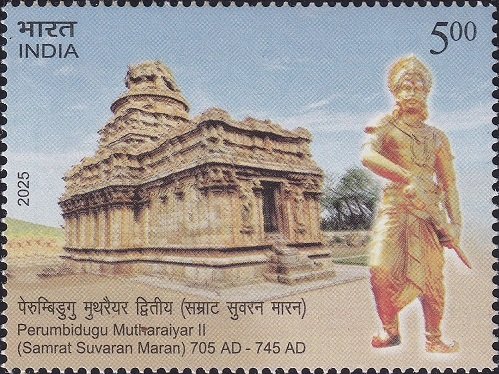 Issued by India
Issued on Dec 14, 2025
Issued for : India Post proudly releases a Commemorative Postage Stamp on the occasion of his 1,350th birth anniversary, celebrating the life and legacy of Perumbidugu Mutharaiyar II, a king whose strength in battle was matched by his wisdom in rule, and whose enduring impact still echoes in the temples, texts, and traditions of Tamil Nadu.
Credits :
Stamp/FDC/Brochure/Cancellation Cachet : Shri Brahm Prakash
Type : Stamp, Mint Condition
Colour : Multi Colour
Denomination : 500 Paise
Stamps Printed : 305130
Printing Process : Wet Offset
Printer : Security Printing Press, Hyderabad
About :
- Perumbidugu Mutharaiyar II was one of the most distinguished rulers of ancient Tamil Nadu. Also known as Suvaran Maran and Perarasar Perumbidugu, he ruled the fertile and culturally vibrant Kaveri delta region with unmatched leadership, courage, and a deep commitment to public welfare during the 8th century CE.
- He reigned from Tiruchirappalli, extending his authority across what is today Thanjavur, Pudukkottai, Perambalur, and Thiruvarur. Belonging to the renowned Mutharaiyar dynasty, which governed the heart of Tamil Nadu between 600 and 900 CE, his lineage is celebrated for its remarkable contributions to military, administrative, religious, and cultural spheres. As members of the powerful hunter-warrior communities of India, the Mutharaiyar rulers rose to prominence through their martial skills and became custodians of Tamil society’s spiritual and literary traditions.
- His military campaigns were fought across several strategically significant regions such as Kodumbalur, Manalur, Thingalur, Kanthalur, Azhundhiyur, Karai, Marangur, Pugazhi, Annalvayil, Sembonmari, Vengodal, and Kannanur. These successful campaigns helped solidify his dominion over key trade routes and cultural centers of the Kaveri delta. His exceptional command and fearless leadership earned him several honorific titles which were later engraved in temple pillars and copper plates. These include Chatru Kesari, Abimana Theeran, Vazhvari Vengai, Shri Chathru Mallan, Shri Kalvar Kalvan, Thanjaikon, Vallakkon, and Vanmaran. Each title reflected a distinct facet of his legacy — as a protector, warrior, strategist, and noble ruler.
- Perumbidugu Mutharaiyar II was not only a valiant king but also a generous patron of Tamil literature, poetry, and temple architecture. His court welcomed and supported several celebrated Tamil poets and scholars of the time. Among them were Pachizhvel Namban, Kottatru Vellam Perumanar, Aachariyar Aniruthar, and Amarunilai Ayina Kuvavan Kanchan, whose verses immortalised his achievements and ideals.
- These literary compositions, particularly the Venbaas, were later inscribed on temple walls, ensuring their preservation through generations. The Sendalai Sundhareswarar Temple in Thanjavur district houses many of these inscriptions. These verses not only celebrate his conquests and valour but also offer insights into the cultural and ethical foundations of his rule.
- Equally important was his devotion to religion and temple-building. He extended royal patronage to several temples, including the historic Vallam Ekawari Amman Temple near Thanjavur. This temple, with its deity Pidari Amman (also known as Kaalapidarari), was closely associated with the royal family’s spiritual beliefs. It continues to stand today as a living testimony to the dynasty’s commitment to preserving Shaivite traditions and village-based temple worship.
- The architectural elegance and religious depth of such temples reflected the spiritual ethos of his reign, and his titles Thanjaikon and Vallakkon possibly indicate his personal and dynastic connections to these sacred sites.
- His contributions are acknowledged in revered Tamil literary works like Naladiyar and Muthollayiram, which celebrate the martial traditions and moral wisdom of the Mutharaiyar kings. Inscriptions from sites like Killukottai and Senthalai provide further evidence of the administrative sophistication and cultural patronage during his time.
- Perumbidugu Mutharaiyar II’s reign represents a golden chapter in Tamil history — one where political stability, military excellence, cultural flowering, and religious continuity coexisted. His governance model inspired later rulers and his legacy remains etched into the history of South India.
- Text : Referenced from the content provided by the proponent.