

Marking the birth centenary of Arudra, the 2025 commemorative issue celebrates his enduring contribution to Telugu literature as a poet, writer and scholar who bridged literary scholarship and popular culture :
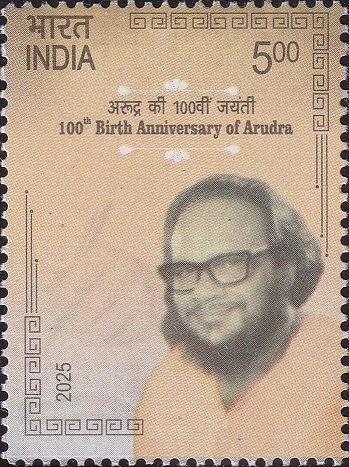 Issued by India
Issued on Dec 16, 2025
Issued for : The Department of Posts is proud to release a commemorative postage stamp honouring a figure who seamlessly bridged the worlds of scholarly excellence and popular culture. He embodies the spirit of inclusivity, creativity, the intellectual rigour that defines India’s literary tradition. This stamp not only celebrates Arudra’s legacy but also highlights the enduring significance of Telugu literature in India’s cultural fabric.
Credits :
Stamp/FDC/Brochure/Cancellation Cachet : Ms. Neetu Arora
Type : Stamp, Mint Condition
Colour : Multi Colour
Denomination : 500 Paise
Stamps Printed : 303280
Printing Process : Wet Offset
Printer : Security Printing Press, Hyderabad
Name : Bhagavatula Sadasiva Sankara Sastry
Born on 31 Aug, 1925 at Visakhapatnam, Andhra Pradesh, India
Died on 4 Jun, 1998
About :
- Bhagavatula Sadasiva Sankara Sastri, better known by his pen name Arudra, made significant contributions to poetry, literary scholarship, cinema, dance research, and cultural preservation. He was a rare blend of creative brilliance and academic rigour.
- Born on 31 August, 1925 in Visakhapatnam, Arudra hailed from a distinguished family whose history stretches back four centuries. His early years were shaped by traditional learning, but he broke away from convention early, rejecting caste-based practices and embracing a humanist worldview. His first poetic awakening came during the Japanese bombing of Visakhapatnam in World War II, which inspired Loha Vihangalu (Metal Birds). This powerful anti-war poem marked his literary debut.
- Arudra’s formative years were eclectic. He served in the Royal Indian Air Force, worked as a photographer, and eventually immersed himself in journalism and the Telugu film industry. His early literary mentors under whose influence Arudra honed his craft, blending modernist aesthetics with social commitment. Throughout his life, Arudra was a relentless learner, whether mastering chess, explore the depths of Telugu literary history and revived near-forgotten classical dance forms like Vilasini Natyam.
- Arudra’s magnum opus, Samagra Andhra Sahityam, remains the most comprehensive documentation of Telugu literary history to date. Originally spanning thirteen volumes, later condensed into four, it traces the evolution of Telugu literature from its origins to the modern era, making it a foundational reference for scholars and enthusiasts alike. His ability to weave historical rigour with engaging narrative ensured that this work became accessible beyond academia.
- As a poet and lyricist, Arudra brought literary finesse to popular culture. He penned over 3,000 film songs, many of which became cultural staples, effortlessly blending poetic sophistication with mass appeal. His film lyrics, from devotional hymns to romantic duets, demonstrated his versatility and deep understanding of both classical and contemporary idioms. His landmark works include Tvamevaham, a searing poetic refection on war and human suffering, and countless film songs that continue to resonate across generations.
- Arudra was also a passionate researcher and revivalist of traditional arts. His scholarship on Vilasini Natyam, a classical dance form, played a pivotal role in its preservation and revival. His interdisciplinary approach-bridging literature, cinema, dance, and even magic, epitomised his belief that true art transcends rigid boundaries.
- Arudra considered himself a Sangha Jeevi, a people’s writer who believed that while epics live on paper, lyrics live in the hearts and voices of the people. This philosophy remains profoundly relevant today as India seeks to balance cultural preservation with modernisation. His works continue to be taught, performed, and discussed, bridging generations and inspiring new waves of Telugu writers, scholars, and artists.
- The centenary of Arudra’s birth has reignited interest in his legacy and reaffirmed his pivotal role in Telugu and Indian cultural history. His vision of making literature accessible without diluting its essence continues to guide contemporary discourse on cultural inclusivity.
- Arudra’s towering contributions to Telugu literature, cinema, and cultural research make him a national figure of enduring significance. His centenary offers a timely and symbolic occasion to honour his legacy, ensuring that new generations across India recognise and celebrate his multifaceted genius.
- Text : Referenced from content provided by the Proponent.