


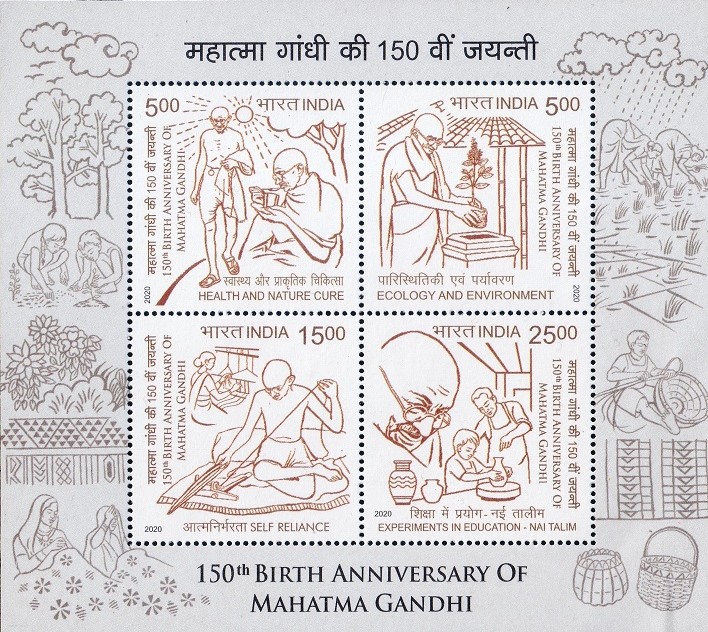
A Miniature Sheet consisting of 4 nos. of postage stamp on the 150th Birth Anniversary of Mahatma Gandhi :
 Issued by India
Issued on Oct 2, 2020
Issued for : Department of Posts is pleased to issue a Miniature Sheet and four Commemorative Postage Stamps to commemorate the 150th Birth Anniversary of Mahatma Gandhi.
Credits :
Stamp/Miniature Sheet/FDC/Brochure/Cancellation Cachet : Sh. Sankha Samanta
Type : Miniature Sheet, Mint Condition
Colour : Multi Colour
Denomination : 500 Paise (2), 1500 Paise, 2500 Paise
Stamps Printed : 500000 each
Miniature sheets printed : 110000
Printing Process : Wet Offset
Printer : Security Printing Press, Hyderabad
About :
- Mahatma Gandhi (2nd October, 1869 – 30th January, 1948), popularly known as Bapu, led the movement against the British rule of India. He is considered the father of the nation and is a well-known name internationally for his doctrine of nonviolent protest (satyagraha) to achieve political and social progress. Bapu’s struggle culminated in India’s Independence on 15th August, 1947. Bapu strived to lead the country to not just political independence but to a better India and a society free of caste, religious, economic and gender prejudices.
- The occasion of 150th birth anniversary celebrations reminds the humanity of the efficacy of the message of Bapu. Bapu’s lessons are relevant in every policy of the country such as Swachh Bharat, rights of women and children and of civil liberties of small and disadvantaged groups, health and well-being of the Indian farmer and the Indian villages.
- Government of India decided to commemorate the 150th birth anniversary of Mahatma Gandhi, Father of the Nation, at national and international level to propagate his message. A National Committee (NC) headed by Hon’ble President of India was constituted for this purpose. This Committee includes Hon’ble Vice-President, Hon’ble Prime Minister, Chief Ministers of all states of the country, representatives from across the political spectrum, Gandhians, thinkers, and eminent persons from all walks of life. An Executive Committee (EC) headed by Hon’ble Prime Minister with 19 members has also been constituted. Mandate of Executive Committee is to consider policies and lay down guidelines for the commemoration and chalk out the plan, programmes and activities under the commemoration.
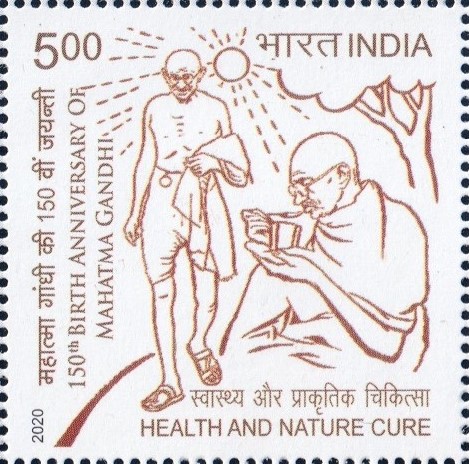
- Bapu’s contribution to the system of nature cure in India is immense. He was a fervent practitioner of naturopathy all through his life. In 1932, Dr. Dinshaw Mehta met Bapu in Bombay (as it was then known) upon the latter’s invitation. This meeting led to a lifelong association and Dr. Mehta remained Bapu’s personal nature cure physician for life. Bapu founded the All India Nature Cure Foundation Trust in 1945. He believed that nature cure means a change for the better in one’s outlook on life itself and regulation of one’s life in accordance with the laws of health.
- A healthy lifestyle envisaged by Bapu comprises harmony amongst three dimensions – the intra-personal, the inter-personal and the environmental/cosmic. “The Earth has enough resources for our need but not for our greed.” Bapu’s concern for maintaining ecological balance and environment is perhaps best captured in the preceding quote. His concern about the environment and ecological impact of urbanization was evident in his speeches and writings.
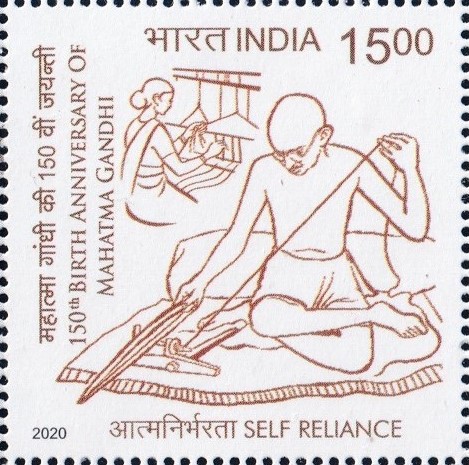
- The idea of Atma-nirbharta or self-reliance has its origins in Bapu’s concept of a self-reliant India, the foundation of his Swadeshi philosophy. Bapu emphasized the idea of self-sufficient village economy. He opined that all goods and services necessary for residents of a village should be available within the village. Bapu stressed on nurturing rural industries including handlooms and handicrafts.
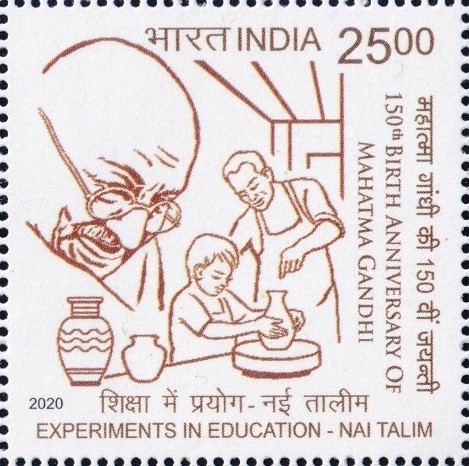
- Bapu was convinced that education can play an effective role in developing a wholesome human personality capable of resisting war, violence, injustice and oppression and building a social order wherein man can live in peace and harmony with others. He concentrated on an education that could draw out the best in the child – body, mind and spirit – for developing a peace loving human personality. Bapu believed that education is closely associated with the socio-economic development of the society. He advocated a scheme for basic education in which vocational training or work experience is of utmost importance.




9 Comments
Republic of India 1950 - iStampGallery
October 2, 2020[…] a quill dipped into an inkpot with a number of leaflets in the background inscribed in Hindi with Mahatma Gandhi‘s favourite hymn ‘Raghupati Raghav Raja Ram‘ and in illustrative of India‘s […]
Raj Kumar Shukla 2000 - iStampGallery
October 2, 2020[…] the “Champaran Satyagraha” marks a very important stage. Raj Kumar Shukla drew the attention of Mahatma Gandhi, who had just returned from South Africa, to the plight of the peasants suffering under an […]
Shyama Prasad Mukherjee 2025 - iStampGallery
October 2, 2020[…] student, Syama Prasad Mookerjee was inspired by the growing freedom movement led by leaders like Mahatma Gandhi, which motivated him to dedicate himself to India’s independence. In the 1920s, he joined the […]
Hindustan Times 2024 - iStampGallery
October 2, 2020[…] Mahatma Gandhi inaugurated The Hindustan Times and selected K.M. Panikkar as its editor. Gandhi’s advice to Panikkar emphasized the importance of honesty and transparency, a principle that remains a cornerstone of the newspaper’s ethos. The early years were challenging, with the paper struggling financially. Pandit Madan Mohan Malaviya provided crucial support by borrowing Rs 40,000 from Punjab National Bank, chaired by Lala Lajpat Rai to cover debts. By 1927, the newspaper was restructured into a limited liability company with Pandit Madan Mohan Malaviya on the board and Ghanshyam Das Birla, a key supporter of Gandhi, as a major shareholder. […]
Gandhian Heritage in Modern India: Gandhi's Living Legacy - iStampGallery
October 2, 2020[…] Mahatma Gandhi is known as the Father of the Nation. Origin of this title is traced back to a radio address (on Singapore radio) on 6 July 1944 by Subhash Chandra Bose where Bose addressed Gandhi as “The Father of the Nation”. On 28 April 1947, Sarojini Naidu during a conference also referred to Gandhi as “Father of the Nation”. The Nation is indebted to him for getting liberation from the yoke of the foreign rule. His influence and legacy pervade diverse aspects of the life and culture of modern India. […]
India on United Nations: 25 Years of Global Cooperation - iStampGallery
October 2, 2020[…] It was again our country which gave birth to the foremost apostle of peace in modern times, Mahatma Gandhi, whose centenary was celebrated only last […]
Ramakrishna Mission - iStampGallery
October 2, 2020[…] has received several awards and recognitions for its selfless service, including the prestigious Gandhi Peace prize for the year 1998, conferred by the Government of India. The prize carried a citation […]
Arvind Mafatlal - iStampGallery
October 2, 2020[…] 1977, he was nominated as Chairman, BAIF. He served in this position until his demise. Inspired by Mahatma Gandhi’s vision for gram-rajya in an independent India, he, along with Manibhai, helped BAIF execute […]
Siddharoodha Swami - iStampGallery
October 2, 2020[…] freedom movement, hosting conferences at his ashram attended by luminaries like Lokmanya Tilak and Mahatma Gandhi as the Chief Guests in the year 1922 and 1924 respectively. His spiritual prowess attracted the […]