Sri Madhvacharya
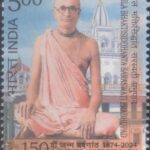
A commemorative postage stamp on Sri Madhwacharya, founder of Dvaita Vedanta (dualistic school of Hindu philosophy) :
Issued by India
Issued on Aug 30, 2025
Issued for : India Post proudly releases a Commemorative Postage Stamp honouring the timeless legacy of Sri Madhvacharya, a philosopher and spiritual reformer whose Dvaita Vedanta school profoundly shaped Indian philosophical thought. His teachings continue to illuminate the path of devotion, knowledge, and righteousness.
Credits :
Stamp/FDC/Brochure/Cancellation Cachet : Ms. Himani
Type : Stamp, Mint Condition
Colour : Multi Colour
Denomination : 500 Paise
Stamps Printed : 303480
Printing Process : Wet Offset
Printer : Security Printing Press, Hyderabad
Name : Vasudeva
Born on 1238 CE at Pajaka, Udupi taluk, Karnataka, India
Died on 1278 CE
About :
- Sri Madhvacharya, the founder of the Dvaita (dualistic) school of Vedanta, was born around 1238 CE in the village of Pajaka near Udupi, in present-day Karnataka, India. He belonged to a Tulu Brahmin family and exhibited a deep spiritual inclination from an early age. Known for his extraordinary intellect, physical strength, and devotion, he began his formal education under his father, Madhyageha Bhatta, and local scholars.
- By the age of 16, Madhvacharya chose to renounce worldly life and took monastic vows (Sannyasa) under Achyutapreksha, the head of a local Advaita monastery. However, over time, he developed philosophical ideas that challenged the core tenets of Advaita Vedanta.
- Sri Madhvacharya’s principal contribution to Indian philosophy was the establishment of Dvaita Vedanta. The dualistic philosophy stood in direct contrast to the non-dualistic Advaita school founded by Adi Shankaracharya. According to Madhvacharya, the individual soul (jiva) and the Supreme Being (Vishnu or Narayana) are eternally separate. He strongly asserted the reality of the world, the distinction between God and the soul, and the importance of bhakti (devotion).
- Sri Madhvacharya argued that liberation (moksha) is achieved not through knowledge alone but through unwavering devotion to Vishnu, adherence to Dharma (righteous duty), and divine grace. His vision placed God as supreme and unchanging, with individual souls in eternal servitude to the divine.
- A prolific writer and teacher, Sri Madhvacharya composed numerous works that laid the foundation of Dvaita philosophy. Key among them are:
- Brahma Sutra Bhashya – A commentary that systematically critiques earlier interpretations, particularly those of Shankaracharya.
- Bhagavad Gita Tatparya – A detailed exposition of the Gita’s spiritual teachings.
- Mahabharata Tatparya Nirnaya – An interpretive text revealing the deeper meanings of the Mahabharata.
- Upanishad Bhashyas – Commentaries on select Upanishads, offering dualistic interpretations.
- Dwadasha Stotra – A collection of twelve devotional hymns dedicated to Lord Vishnu.
- These works, rich in logic and devotion, laid the groundwork for the Dvaita school’s development and spread, influencing future generations of thinkers and devotees.
- One of Sri Madhvacharya’s most enduring legacies is the establishment of the Udupi Krishna Matha, a temple dedicated to Lord Krishna in Udupi. According to legend, he recovered an idol of Krishna from a shipwreck and installed it in the temple, which became the spiritual and organizational center of the Dvaita tradition.
- To manage religious and administrative duties, Sri Madhvacharya founded Ashta Mathas (eight monasteries) and appointed his closest disciples as heads. These Mathas continue to function today, playing a certain role in preserving and promoting Dvaita Vedanta and the worship of Krishna.
- Sri Madhvacharya’s teachings left a deep mark on Indian philosophy and devotional practice. His emphasis on the personal relationship between the soul and God resonated deeply with later bhakti movements across India. Communities, especially among Tulu and Kannada-speaking Brahmins, embraced his dualistic teachings and devotional emphasis.
- His rational, theistic philosophy offered a strong counter-narrative to Advaita Vedanta and influenced subsequent theological debates. Today, his works are studied by scholars and devotees alike, and the institutions he established remain vibrant centers of learning and spiritual practice.
- Sri Madhvacharya is revered not only as a philosopher but also as a saint, mystic, and reformer. His life of devotion, scholarship, and service continues to inspire millions, securing his place as one of the most significant figures in the spiritual and philosophical traditions of India.
- Text : Based on information provided by the proponent.