Shyama Prasad Mukherjee 2025
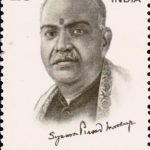
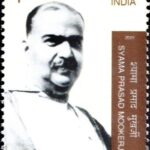
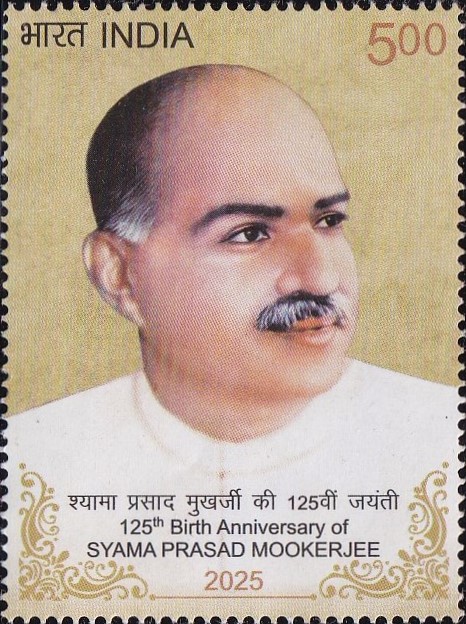
A commemorative postage stamp on the 125th Birth Anniversary of Syama Prasad Mukherjee, founder of Bharatiya Jana Sangh :
Issued by India
Issued on Jul 9, 2025
Issued for : The Department of Posts is proud to release a commemorative postage stamp on 125th Birth Anniversary of Syama Prasad Mookerjee, a visionary leader, educationist, and nationalist whose ideals continue to guide and influence India’s journey. This stamp is a tribute to his lasting contributions to India’s political and educational landscape, his commitment to national unity, and his belief in inclusive development rooted in Indian values.
Credits :
Stamp/FDC/Brochure/Cancellation Cachet : Smt. Nenu Gupta
Type : Stamp, Mint Condition
Colour : Multi Colour
Denomination : 500 Paise
Stamps Printed : 202800
Printing Process : Wet Offset
Printer : Security Printing Press, Hyderabad
Name : Shyama Prasad Mukherjee
Born on 6 Jul, 1901 at Kolkata, West Bengal, India
Died on 23 Jun, 1953 at Srinagar, Jammu and Kashmir, India
About :
- Syama Prasad Mookerjee was born on 6 July 1901 in Calcutta (now Kolkata) into a distinguished Bengali family. His father, Sir Ashutosh Mookerjee, was a renowned educationist and the Vice-Chancellor of the University of Calcutta. Syama Prasad Mookerjee was academically gifted and completed his education at the prestigious Presidency College, Calcutta. He studied law at the University of Calcutta and, in 1926, joined Lincoln’s Inn in London, becoming a member of the English Bar in 1927.
- As a young student, Syama Prasad Mookerjee was inspired by the growing freedom movement led by leaders like Mahatma Gandhi, which motivated him to dedicate himself to India’s independence. In the 1920s, he joined the Indian National Congress and became an active member of its youth wing. However, his vision for India, especially regarding the role of princely states and the structure of the Indian Union, was distinct. From 1943 to 1946, he served as the President of the All India Hindu Mahasabha. Syama Prasad Mookerjee was elected to the Constituent Assembly from West Bengal. He actively participated in debates on minority rights, regional languages, and other key issues.
- On 21 October 1951, Syama Prasad Mookerjee founded the Bharatiya Jana Sangh in Delhi. He strongly opposed the special status granted to Jammu and Kashmir under Article 370 and advocated its abrogation. During a visit to Jammu in August 1952, addressing a massive gathering, he famously said, “I will either get you the Indian Constitution or sacrifice my life for it.” His slogan “One Nation, One Constitution,” reflected his belief in equal rights for all Indian citizens, regardless of their state. Syama Prasad Mookerjee maintained a strong connection with South India through his contributions to the fields of education, industry, and linguistic inclusivity. He served as the Vice-Chancellor of the University of Calcutta from 1934 to 1938 and was a member of the Council of the Indian Institute of Science (IISc), Bengaluru, in 1935. As an educationist, he emphasised the importance of learning one’s mother tongue while appreciating other languages. He advocated for the inclusion of regional languages like Tamil and Telugu in university curricula.
- As a Minister for Industry and Supply, he worked to support small-scale industries, including taking concrete steps to aid handmade matchstick producers in Tamil Nadu – such as tax relief and ensuring access to raw materials and transport. He also encouraged the Madras Government to organise these workers into cooperatives for long-term sustainability. These interventions highlight his commitment to inclusive national development and his engagement with concerns of the southern states. Integral Humanism, later shaped by Pandit Deendayal Upadhyaya, advocated a development model based on India’s cultural and civilisational values – balancing material progress with spiritual and cultural well-being. While the term became popular after Syama Prasad Mookerjee’s time, his ideas and speeches reflected this philosophy. He consistently emphasised that India’s progress should not blindly imitate the West but be rooted in its own cultural and moral foundations. Speaking at the 1936 convocation of Nagpur University, he stated: “Generally speaking, an Indian university must regard itself as one of the living organs of national reconstruction. It must discover the best means of blending together both the spiritual and the material aspects of life.”
- Antyodaya, or the upliftment of the last person in society, was central to the social vision of leaders like Mahatma Gandhi and later Pandit Deendayal Upadhyaya. While Syama Prasad Mookerjee did not use the term directly, his political and educational work emphasised justice, equality, and inclusion, particularly for the underprivileged. At the 1940 convocation of Agra University, he clearly articulated this thought: “Political and social justice requires, not the disintegration of a country and destruction or humiliation of a class which shows initiative, intelligence and drive, but equality of opportunity for all, genuine freedom for self-fulfilment, in which all men irrespective of caste or creed may share.” Syama Prasad Mookerjee’s luminous journey came to an untimely end on 23 June 1953, marking a solemn moment in India’s history.
- Text : Referenced from content provided by Proponent.