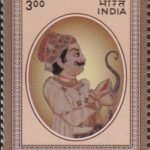


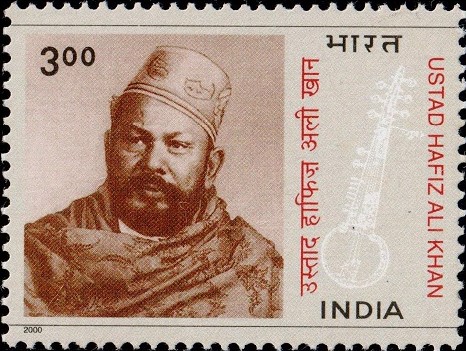
A commemorative postage stamp on the exponent of Sarod, Hafiz Ali Khan, father and Guru of Amjad Ali Khan :
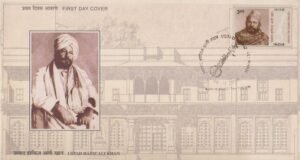
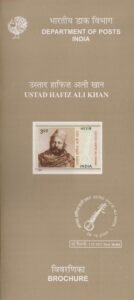 Issued by India
Issued on Dec 28, 2000
Issued for : The Department of Posts is happy to issue this commemorative stamp in honour of Ustad Hafiz Ali Khan.
Credits :
Stamp : Calcutta Security Printers Ltd. – based on the concept design by Alka Sharma
FDC : Sankha Samanta
Cancellation : Alka Sharma
Type : Stamp, Mint Condition
Colour : Five Colour
Denomination : 300 Paise
Overall size : 2.91 x 3.9 Cms.
Printing size : 2.91 x 3.9 Cms.
Perforation : 13.5 x 13.5
Paper : Matt Chromo
Stamps Printed : 0.4 million
Number per issue sheet : 40
Printing Process : Photo Offset
Printer : Calcutta Security Printers Ltd.
Name : Hafiz Ali Khan
Born on 1888 at Gwalior, Madhya Pradesh, India
Died on 1972 at Mumbai, India
About :
- Ustad Hafiz Ali Khan (1888-1972), one among the great exponents of the Sarod, was a torchbearer of the glorious musical legacy of Gwalior. The legendary Tansen, perhaps the best known Indian dhrupdiya of all time was from Gwalior.
- Of all the stringed musical instruments, sarod has now become one of the most popular. The present day sarod is the improvised and modified form of old rabab which was first introduced in India by the Afghans who came here from Kabul and settled in many places of Northern India.
- Hafiz Ali Khan was born in a family of musicians, particularly famed for their mastery of the sarod. Coming from a family with a rich tradition of music with patronage received from many courts, Hafiz Ali enjoyed good social and economic status. He was a religious minded person. Hafiz Ali Khan was given training in music by his father Ustad Nanhe Khan from the age of 6 years and continued it for 13 years. After the death of his father, he did not lose courage but with hard rigorous practice he perfected his art and soon earned the title of “Aftabe Sarod”. A keen student, he equipped himself in both vocal and instrumental music by training under great masters like Chukkalal and Ganeshilal of Brindawan (Dhrupad Dhamar style), Ganpatrao Bhaiya Saheb of Gwalior (Thumri style) and Ustad Wazzeer Khan of Rampur (Been and Sarod).
- After different training stints, he returned to Gwalior and became the court musician of Maharaja Madhav Rao Sindhia. Hafiz Ali participated in many music conferences and sammelans and earned praise and popularity. His music career also saw him moving to Calcutta, where he lived and performed for nearly 10 years.
- Hafiz Ali was an ardent believer and practitioner of old traditional methods. The charm of his performance was his inherent vitality, ability to entertain and sustain his listeners’ interest. Having learnt Dhrupad, Dhamar, grandiose style and the light romantic thumri style his performances were always melodious, pleasing and refreshing. He preferred the accompaniment of Pakhawaj, instead of tabla in his performance. He was a purist and did not defile the melody pattern and characteristics of the established traditional ragas by making changes in the note-pattern, synthesizing old Hindustani Ragas with Karnataki Ragas and newly self-composed Ragas. He did not favour the wave of neo-classicism. But he did not discourage his disciples or his own son Amjad Ali to try these new experiments. He was one of the top ranking instrumentalists. He had helped to popularise the traditional style of playing Sarod. He has trained many disciples, amongst them is his son Ustad Amjad Ali Khan of worldwide fame. He was awarded the title of ‘Padma Bhushan’ in 1960 by the President of India.
- The house where Ustad Hafiz Ali Khan used to live in Gwalior has now been converted into ‘Sarod Ghar’ – a museum for musical heritage, and stands as a testament to the glorious contribution made by him to the world of music.
- Text : National Biography Series edited by SP Sen, and material furnished by the sponsors.
![2382 Ustad Bismillah Khan [India Stamp 2008]](https://istampgallery.com/wp-content/uploads/2015/10/2382-Ustad-Bismillah-Khan-India-Stamp-2008.jpg "Ustad Bismillah Khan")