

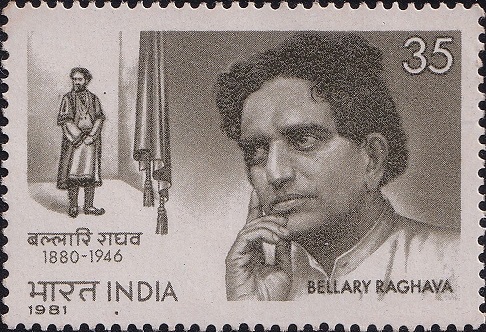
A commemorative postage stamp on Bellary Raghava (Tadipatri Raghavacharlu), a great Indian theatre actor :
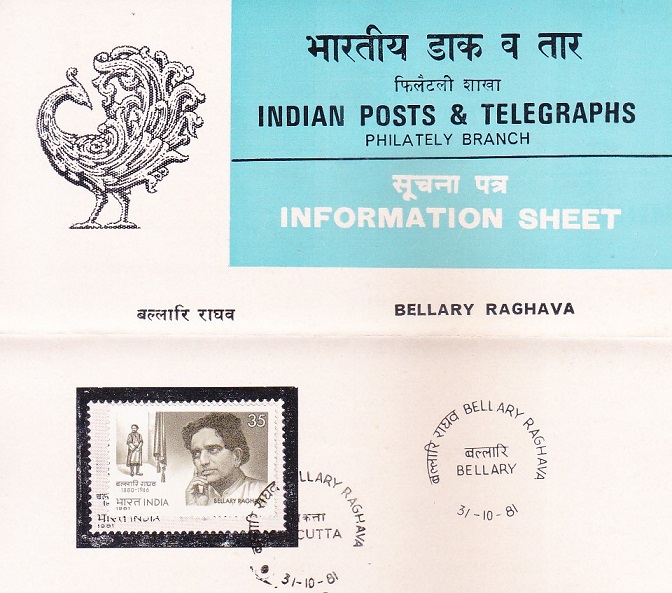 Issued by India
Issued on Oct 31, 1981
Issued for : The P & T Department is privileged to issue a commemorative stamp in his honour.
Description of Designs : The stamp, designed by India Security Press, shows a portrait of the personality against the background of a stage. First day cover, designed by India Security Press, shows him in one of his stage roles. Cancellation was designed by Charanjit Lal.
Type : Stamp, Mint Condition
Colour : Raw Sienna
Denomination : 35 Paise
Overall size : 4.06 x 2.75 cms.
Printing size : 3.70 x 2.40 cms.
Perforation : 14 x 14½
Paper : Unwatermarked P. G. matt coated paper
Number printed : 20,00,000
Number per issue sheet : 40
Printing process : Photogravure
Printed at : India Security Press
Name : Tadipatri Raghavacharlu
Born on 2 Aug, 1880 at Tadipatri, Anantapur district, Madras Presidency, British India [now in Andhra Pradesh, India]
Died on 17 Apr, 1946 at Chennai, India
About :
- Tadipatri Raghavacharlu, popularly known as Bellary Raghava was a renowned actor. He was born on 2 August 1880. He received his early education at Bellary and later graduated in law from the Madras University. His uncle Dharmavaram Ramakrishnamachari, who was a pioneering dramatist in Telugu, initiated him on the stage. He was also associated with another great dramatist, Kolachalam Srinivasa Rao.
- An accomplished actor of extra-ordinary calibre he is known for supreme mastery of expression. Expressive eyes set in a mobile face, he could modulate his visage and resonant voice to suit the emotion appropriate to any role, from that of a vidushaka to a maharaja.
- He was equally at home in plays in English, Telugu, Kannada and Hindi; his three main centres of activity were Bellary, Bangalore and Madras. At Bangalore he founded the Amateur Dramatic Association of Bangalore in 1909. He advocated and developed the naturalistic style in acting. He was very particular that women should always play the female roles on the stage. In 1927 he went to England and took part in English dramas with Laurance Olivier and Charles Laughton. On his return to India he encouraged playwrights to set aside the classical style and to take to naturalistic plays. Instead of protracted declamations and conversations, he advocated short dialogues coupled with appropriate gestures. His presentation of Tappevaridi by Rajamannar in 1930 in Madras was hailed by many as a momentous event heralding a new era. Among his admirers were Mahatma Gandhi, Rabindranath Tagore and Bernard Shaw.
- The arrival of the movies was a blow to the promise of a modern theatre that Raghava envisaged. He tried his hand at acting in films but this satisfied neither him nor his audience.
- Besides being a versatile actor, he was also a busy lawyer and an ardent social worker. All his earnings were spent in development of the art that was his passion and for the uplift of the down-trodden. As a man he was endearing and as an actor he was incomparable. After doing yeoman service to the cause of the Indian theatre he passed away on 17 April 1946.
- (The above text is based on material supplied by sponsors.)

![1445 Prithvi Theatre [India Stamp 1995]](https://istampgallery.com/wp-content/uploads/2015/08/1445-Prithvi-Theatre-India-Stamp-1995.jpg "Prithvi Theatre")

![Gaiety Theatre Complex, Shimla [India Stamp 2014]](https://istampgallery.com/wp-content/uploads/2016/04/Gaiety-Theatre-Complex-Shimla-India-Stamp-2014-150x150.jpg "Gaiety Theatre Complex, Shimla")
![944 Checkered Skipper Butterfly [England Stamp 1981]](https://istampgallery.com/wp-content/uploads/2015/09/944-Checkered-Skipper-Butterfly-England-Stamp-1981.jpg "Butterflies of England 1981")