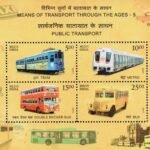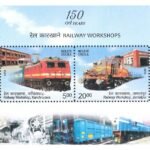


The 2025 issue marks 100 years of electrification in Indian Railways, tracing a century of electric traction from the first electric train in 1925 to modern, efficient and sustainable rail transport :
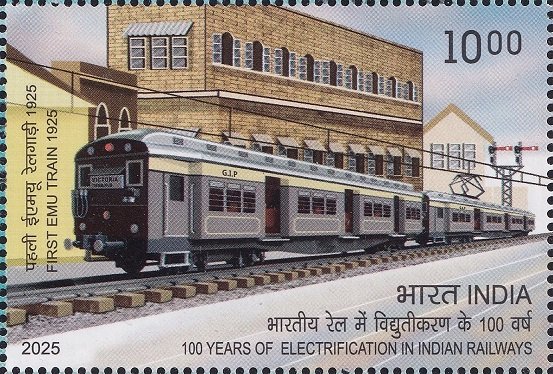
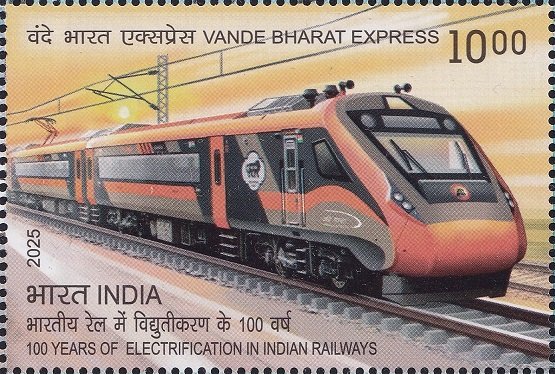
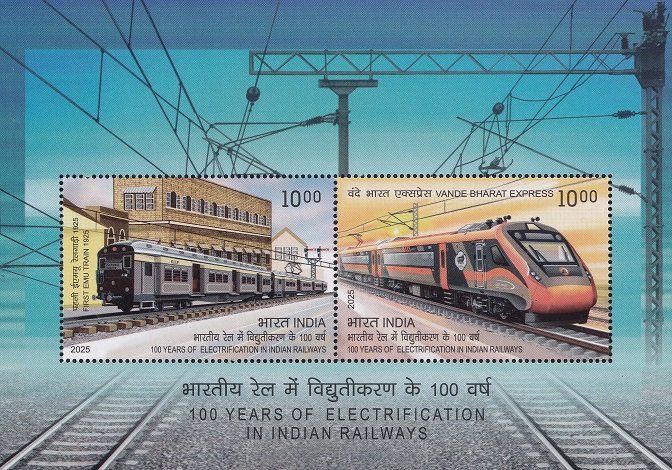 Issued by India
Issued on Dec 31, 2025
Issued for : Department of Posts is delighted to release a Miniature Sheet consisting two stamps on 100 years of electrification in Indian Railways and appreciates its contribution in economic development and steadfast commitment in transforming transportation in India.
Credits :
Stamp/FDC/Brochure/Cancellation Cachet : Sh. Sankha Samanta
Type : Miniature Sheet, Mint Condition
Colour : Multi Colour
Denomination : 1000 Paise (2)
Miniature Sheets Printed : 215000
Printing Process : Wet Offset
Printer : Security Printing Press, Hyderabad
About :
- The Indian Railways, a symbol of national integration and economic development, has played a pivotal role in transforming transportation in India. Among its many achievements, the adoption of electric traction stands as a testament to its forward-thinking approach and commitment to sustainability.
- The history of electric traction in India dates back to 1925 when the first electric train ran on the Harbour Line between Bombay V.T. (now Chhatrapati Shivaji Maharaj Terminus) and Kurla. This marked the advent of a new era with cleaner and more efficient electric traction. The initial electrification was done using 1.5 kV DC system, demonstrating a leap in technology and modernization for the time.
- Following its initial success, the Indian Railways embarked on expanding its electrified network. Post-independence, the focus shifted towards standardizing the system to 25 kV AC, which became the preferred choice for electrification worldwide due to its economical and operational benefits. By the 1960s, this transition was in full swing, laying the foundation for widespread railway electrification across the country.
- Electric traction has been a cornerstone of India’s industrial and economic development. By enhancing the efficiency of rail transport, electric traction has facilitated the seamless movement of goods across the country, promoting industrial growth and improving connectivity between urban and rural regions.
- By reducing reliance on fossil fuels, electric traction has made a significant contribution to environmental sustainability. With the adoption of energy-efficient technologies and the integration of renewable energy sources like solar and wind power, Indian Railways has become a frontrunner in eco-friendly transportation, helping to minimise the nation’s carbon footprint.
- In the last decade, Indian Railways has witnessed exponential growth in railway electrification. This growth aligns with the government’s vision to enhance energy efficiency, reduce dependence on imported fossil fuels, and reduce greenhouse gas emissions.
- Under accelerated electrification programs, Indian Railways has electrified over 44,000 route kilometers in the past 10 years, including more than 30,000 route kilometers in the last five years, and is progressing toward achieving 100% electrification of its broad-gauge network by 2025.
- As Indian Railways celebrates 100 years of electric traction, it also acknowledges the legacy of innovation and progress that has propelled it forward. The exponential growth of railway electrification is a reflection of India‘s ambition to modernize infrastructure and embrace sustainable practices.
- This milestone is not just a celebration of the past but also a vision for the future, where Indian Railways continues to lead the way in green transportation and nation-building.
- Text : Based on the content provided by the proponent.