


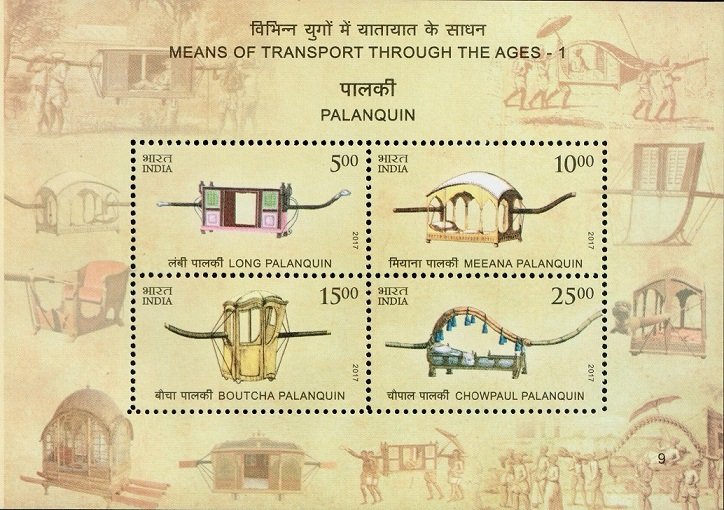
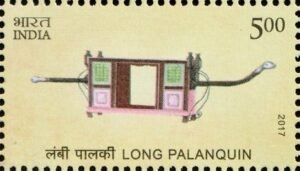
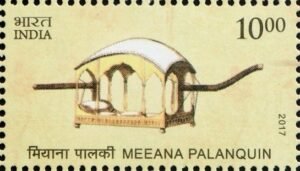
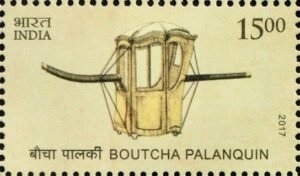
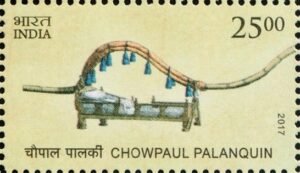
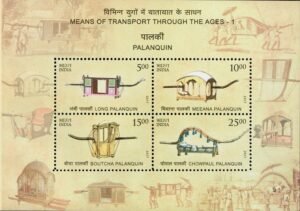
As part of the 2017 “Means of Transport through the Ages” series, the Palanquin issue showcases four traditional forms – Long, Meeana, Boutcha and Chowpaul – offering a glimpse into India‘s historic modes of transport :
 Issued by India
Issued on Mar 25, 2017
Issued for : The Department of Posts is pleased to bring out a Prestige booklet on Modes of Transport through Different Ages with 6 mixed Sheetlets.
Credits :
Stamps/Booklet/Sheetlets/Maxim Cards/FDCs/Brochure/Cancellation Cachets : Shri Brahm Prakash
Type : Sheetlets, Mint Condition
Colour : Multi Colour
Denomination : 500, 1000, 1500, 2500 Paise
Sheetlets Printed : 15000 each
Prestige Booklet Printed : 50000
Maxim Cards Printed : 3000 each
Printing Process : Wet Offset
Printer : India Security Press, Nasik
About :
- From the beginning of history, human sensitivity has revealed an urge for mobility leading to a measure of society’s progress. The history of this mobility or transport is the history of civilization. A well-known and co-ordinated system of transport plays an important role in the sustained economic growth of a country. It has been seen throughout the history of any nation that a proper, extensive and efficient transport provides indispensable mobility for all citizens and goods and contributes to the economic prosperity of a nation. It is a key factor to social, regional and economic cohesion, including the development of rural areas. It is the essential convenience with which people not just connect but progress. Transport is vital to the economic development and social integration of the country.
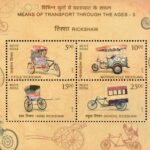
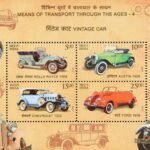
- The Department of Posts is bringing the history of gradual progression in the modes of transportation in country through 20 beautiful Stamps in the form of Prestige Booklet and mixed Sheetlets.
- In the ancient times Palanquins were used as mode of transport. Palanquin, also known as palki, derived its name from the Sanskrit word ‘Palanki’ for a bed or couch. A palki was bigger in size and made of wood. There were doors on both sides. A long cylindrical pole was attached to it lengthways through the middle. A palki was usually carried by six or four men. During medieval India Palki were used as most essential wedding transportation means. It was also used to be the conveyance for noble Indian women as well as for Indian landlords of that time. The use of Palanquins is mentioned in literature as early as the Ramayana also. First four stamps depict the different models of palanquins used by people. The introduction of rickshaws in the 1930’s and ever expanding communication system have now made palki an institution of the past and is now used only on special occasions like wedding ceremonies.
- Text : Based on the material available on internet.

1 Comment
Bullock Carts & Horse Carriages: Indian Transport Heritage - iStampGallery
March 25, 2017[…] four stamps portray different modes of transport related to Horse Carriages and Carts. Apart from Palkis, Bullock Carts and Horse Carriages were also used as a major mode of transport since ancient times. […]