

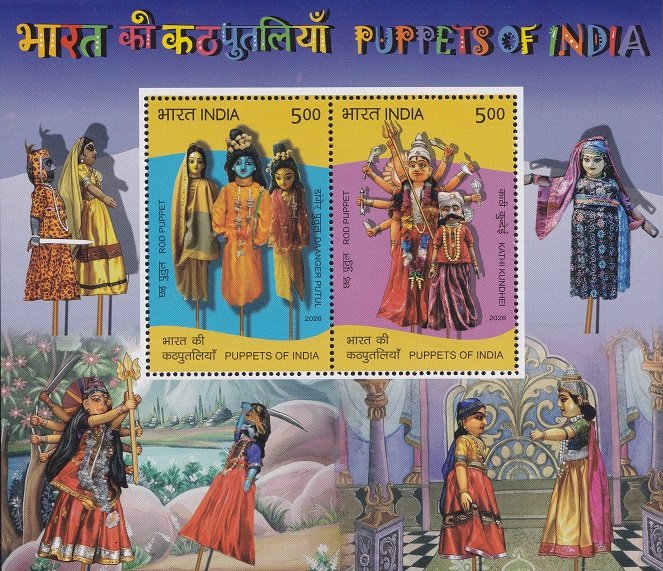
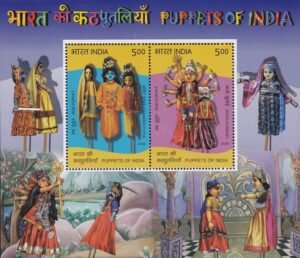
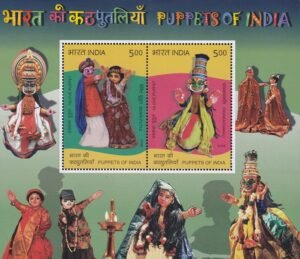
Complete set of 4 nos. of miniature sheets consisting of 8 nos. of postage stamps on the Indian Puppetry showing String Puppet, Rod Puppet, Glove Puppet and Shadow Puppet :
 Issued by India
Issued on Feb 13, 2026
Issued for : Department of Posts is pleased to issue a set of Four Miniature Sheets and One Sheetlet on Puppets of India, which represent an important and vibrant form of cultural expression, reflecting India’s artistic heritage, storytelling traditions, and craftsmanship passed down through generations.
Credits :
1. Sankha Samanta – For Stamp, First Day Cover, Brochure, Miniature Sheet, Sheetlet and Cancellation Cachet.
2. Sangeet Natak Akademi for reference images and text.
3. Indira Gandhi National Centre for the Arts for reference images.
4. Daricha Foundation for reference images.
5. Dadi Pudumjee, founder The Ishara Puppet Theatre Trust for reference images and guidance.
Type : Miniature Sheet, Mint Condition
Colour : Multi Colour
Stamp Denomination : 500 Paise (8)
Miniature Sheets Denomination : 1000 Paise (4)
Sheetlets Denomination : 8000 Paise
Miniature Sheets Printed : 111000 (4)
Sheetlets Printed : 111000
Printing Process : Wet Offset
Printer : Security Printing Press, Hyderabad
About :
- The earliest reference to puppetry in India is in the epic Mahabharata, dating back to around the ninth century BC. Panini, the Sanskrit grammarian of fourth century BC, and Patanjali, the author of Yogasutra, mentioned puppets in their works; so did Tiruvalluvar, the Tamil poet of second century BC, who wrote: ‘the movements of a man who has not a sensitive conscience are like the simulation of life by marionettes moved by strings‘.
- In classical Sanskrit theatre, Sutradhara literally, the holder (dhara) or manipulator of strings (sutra) introduces and directs the play. The term is also used for an architect or carpenter. God, who holds the strings of the destinies of human beings in his hands, is referred to as the Sutradhara.
- India has almost eighteen to twenty living traditions of glove, string, rod and shadow puppetry, spread across its length and breadth. India has all four types of traditional puppets : string, glove, rod and the shadow puppet. String puppets are prevalent in Andhra Pradesh, Assam, Karnataka, Maharashtra, Manipur, Odisha, Rajasthan, Tamil Nadu and West Bengal. Rod puppets are used in Jharkhand, Odisha, and West Bengal. Glove puppets in Kerala, Odisha, Uttar Pradesh and West Bengal. Shadow puppet traditions have continued in Andhra Pradesh, Karnataka, Maharashtra, Odisha and Tamil Nadu. Traditional puppet plays in India enact stories from the Ramayana, the Mahabharata and the Puranas, besides local myths and tales. The puppeteer is the conveyor and interpreter of these messages. Through his magical world of puppets he can transport the audience to a mythical time that stands still, or bring them down to earth with lively comments on the contemporary scene.
- The design, size, costumes and colours of the puppets are largely determined by the characters they portray. Sometimes they speak in their own special language of whistling voices or modulated delivery. The traditional art is transmitted from generation to generation in the family, and children learn manipulation of puppets by watching and assisting their elders perform.
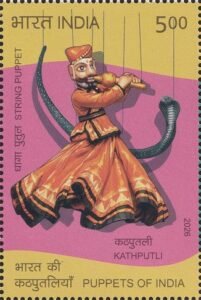
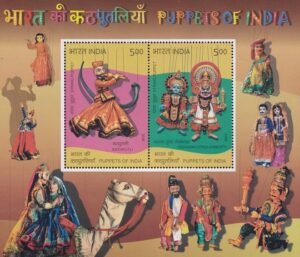
- KATHPUTLI
- Kathputli of Rajasthan is the most visible form of string puppet across a large part of northern India. The manipulators of the Kathputli, a puppet made of Kath or wood, are nats or bhats, a wandering community who perform during the dry season, and return to their villages to cultivate the fields after the rains. The puppeteers believe in a divine origin of their art and claim to have been the chief performers during the reign of the legendary king Vikramaditya, whose life and achievements they extol. The stories in the performing arts of Rajasthan mostly revolve around the exploits of local heroes. Amar Singh Rathore, the ruler of Nagaur in the seventeenth century, from where the puppeteers’ community has its origin, was a great patron whose heroic deeds and death are sung and enacted.
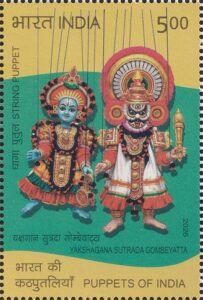
- YAKSHAGANA SUTRADA GOMBEYATTA
- Puppetry in Karnataka has ancient roots, with references to leather puppets in the Neminath Purana and string puppets by the saint Basavanna. The Vijayanagara kings actively patronized this art. The main surviving forms are Sutrada Gombeyatta (string puppetry) and Togalu Gombeyatta (shadow puppetry), while Keelu Gombeyatta is now extinct. String puppet theatre closely resembles Yakshagana in themes, music, costumes, and performance style. Stories are drawn mainly from the Ramayana, Mahabharata, and Puranas. Large wooden puppets are manipulated by strings, accompanied by singers and percussion instruments. String puppet plays are variously known as Sutrada Gombeyatta in the Southern Mysore area, Gombeyatta in the north and Yakshagana Gombeyatta of the coastal districts of Karnataka. The string puppets, up to 1 metre high and weighing about 6 to 8 kilograms, are shaped out of light and durable varieties of wood. Distinguishing features of the northern and coastal puppets are their legs, and hip and knee joints, which enable them to perform complex dance movements.
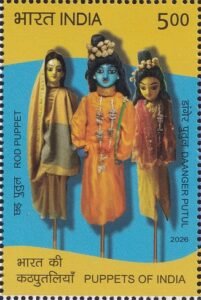
- DAANGER PUTUL
- Daanger Putul Nach features a traditional repertoire of about twelve plays based on the Ramayana, along with popular social, historical plays of Jatras, and Bengali tales. Performances include operatic singing, expressive gestures, declamatory dialogue, and ornate costumes with zari crowns and velvet jackets, lasting up to three hours. The large rod puppets, up to 1.25 meters tall, are carved from wood and painted in the pata style. A bamboo-and-cloth stage with painted backdrops is used. Puppeteers, mainly from Southern West Bengal, perform with musical accompaniment of khol, nagara, harmonium, and cymbals.
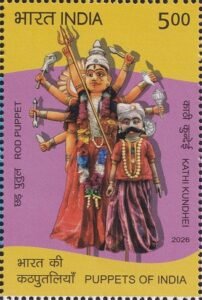
- KATHI KUNDHEI
- The dance of dolls manipulated by kathi (a wooden rod) is a reconstructed form of an older puppetry tradition. Performances begin with a stuti, followed by the Sutradhara introducing an episode from the Ramayana, Mahabharata, or Puranas, such as the battles of Durga and Mahishasur or Rama and Ravana. The puppets, about 60 centimeters tall, have carved and painted wooden heads, jointed shoulders, and costumes resembling Jatra theatre. Arm movements are controlled by internal strings. Puppeteers operate from behind a screen, accompanied by drummers, cymbal players, and reed instrument musicians.
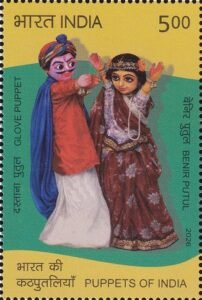
- BENIR PUTUL
- Traditional glove puppet theatre from West Bengal in north-east India. In the south of West Bengal, glove puppets carry the curious name of “Merchants’ Puppets” (benir or bener putul). The name also means “braiding of hair” and refers to the movement of the puppets, which twist and turn like hair being braided. Benir Putul performers are largely concentrated in the Medinipur District. The two male and female characters with terracotta heads and wooden hands or stumps are constantly sparring with each other. The puppets keep the rhythm with bells or cymbals tied to their wrists. The one-or-two man groups travel from village to village giving performances.
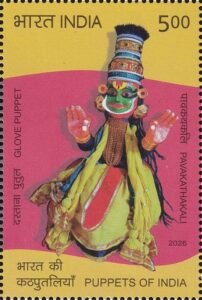
- PAVAKATHAKALI
- Pavakathakali, a glove puppet theatre of Kerala, emerged about two centuries ago under the influence of the classical dance-drama Kathakali. By adapting Kathakali techniques and modelling puppets on its characters, this unique art form developed. The word Pava means “puppet” and Kathakali means “story play”. Pavakathakali is especially important for presenting Kathakali stories through puppetry. From its origin, it was mainly meant to entertain and educate children. Through performances in homes and festivals, children became familiar with the Ramayana and Mahabharata, while also learning important moral values and ideals.
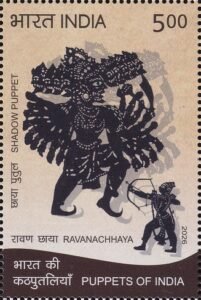
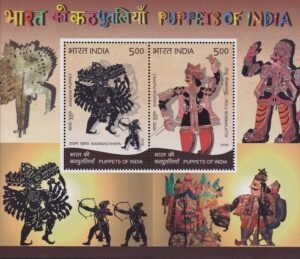
- RAVANACHHAYA
- Ravanachhaya, meaning “Shadow of Ravana,” is an Odisha shadow puppet tradition based on the story of Rama, named after Ravana because Rama is believed not to cast a shadow. It follows the Odia version of Vichitra Ramayana of Vishvanath Khuntia and is also called Ramlila or Ramanataka. Once popular in Angul and Dhenkanal, it now survives mainly in Odasa region of Angul district. Simple, unpainted leather puppets create dark silhouettes. Performances use a dhoti screen, oil lamps for light, ritual prayers, and music with khanjani, daskathi, and kubuji.
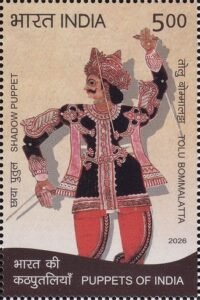
- TOLU BOMMALATTA
- Tolu Bommalatta, the shadow puppet theatre of Andhra Pradesh, is one of the earliest extant folk forms of the region. Etched in multiple colours, the mythological and imaginary puppet figures create a rare combination of nearness and distance through their translucence behind a white screen – the product being a series of aesthetically satisfying pictorial designs coming to life through movement, song and word. One of the fascinating features of these puppet shows is the creative exuberance of the manipulator-singer-performers.