




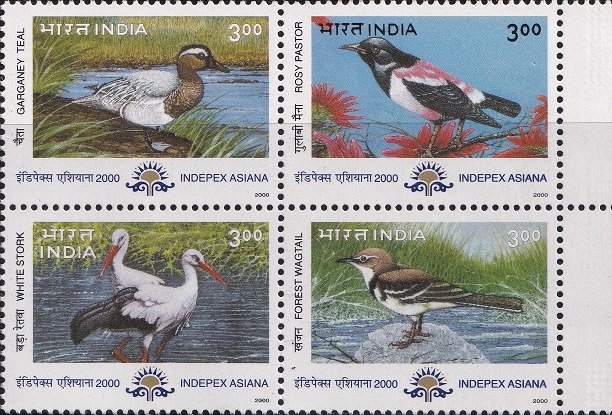
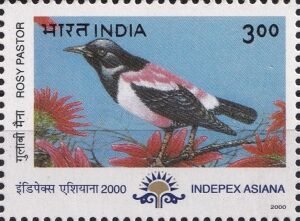
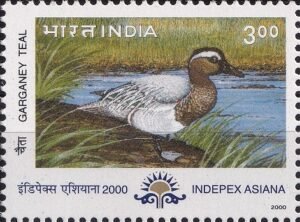
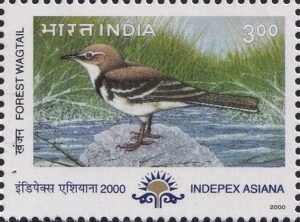
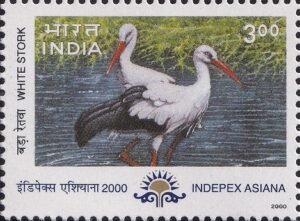
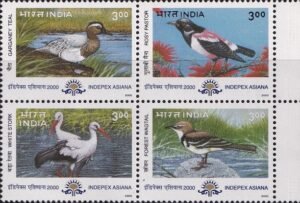
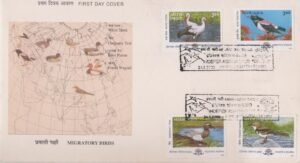
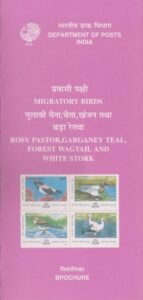
Complete Set of 4 nos of postage stamps on the Indian Migratory Birds : Rosy Pastor, Garganey Teal, Forest Wagtail and White Stork, during “Indepex-Asiana 2000” 14th Asian International Stamp Exhibition, Calcutta :
 Issued by India
Issued on May 24, 2000
Credits :
Stamp & Miniature Sheet : Ramesh Sukumar
FDC : Based on design furnished by Bombay Natural History Society, Mumbai
Cancellation : Alka Sharma
Type : Stamps, Mint Condition
Colour : Six Colour
Denomination : 300, 300, 300, 300 Paise
Overall size : 2.9 X 3.9 Cms.
Printing size : 2.55 X 3.55 Cms.
Perforation : 13.5 x 13.5
Paper : Matt Chromo
Stamps Printed : 1 Million and 0.5 Million Mixed Sheets
Number per issue sheet : 40
Printing Process : Photo Offset
Printer : Calcutta Security Printers Ltd.
About :
- The subject of migration is one of the most enthralling branches of the study of bird life. The magnitude of the movements and the regularity and orderliness of their occurrence have aroused the wonderment of Man, through the ages. Many speculations have been put forward from time to time as to how migratory birds oriented themselves. But it is only within the last few years that ingenious experiments have indicated that day-flying migrants maintain their course from the angle the sun makes with the earth at the appropriate season, while nocturnal migrants are guided by the major constellations of stars. Probability is lent to these findings by the commonly observed fact that in cloudy weather when the sky remains obscured for prolonged periods migrating birds often lose their way.
- In India, a great influx of migratory birds takes place annually during winter, between September and November. One cannot fail to notice their abundance in winter where none were to be seen a couple of months before. The birds which dominate the migration map of the sub-continent are the White Stork, Pintail, Common Teal, Garganey Teal, Redcrested Pochard, Marsh Sandpiper, Rosy Pastor and Forest Wagtail. In any given locality, some of the migratory birds seen are winter visitors which stay throughout the season where as others are passage migrants which stop over briefly on the way to or return from winter quarters. The set of stamps depicts four prominent species of migratory birds seen in India – Rosy Pastor, Garganey Teal, Forest Wagtail and White Stork.
- Rosy Pastor (Sturnus roseus) is a distinctive rose-pink starling, or myna, with a glistening black head, neck, upper breast, wings and tail. It is a winter visitor to India and moves from the north-west eastward to Bihar, straggling into West Bengal, Assam and Bangladesh. It is also seen throughout the Peninsula, decreasingly through Kerala and southern Tamil Nadu. The species can be in small parties or large flocks, and prefers the neighbourhoods of cultivation, especially jowar and bajra. One of our earliest migrants entering the northwestern parts of the subcontinent by middle July, bulk passage of adults and young occurs between August and October. Return transit is usually observed in March and April. It breeds in south-east Europe and south-west Asia, mainly during May and June.
- The Garganey Teal (Anas querquedula) is one of our commonest and most widespread migratory ducks. Smaller in size than Duck, it is one among the earliest to arrive in its winter quarters, and one of the last to leave. Small parties of this duck are occasionally seen till well into May. It is well distributed throughout India and frequents every type of water bodies, large and small jheels, marshes, village tanks, coastal backwaters and lagoons. Difference in colouration distinguish the male from female. Known breeding areas include Europe, Russia, Mongolia and Japan.
- The Forest Wagtail (Motacilla indica), slightly bigger than sparrow in size, has olive-brown upper side and blackish brown wings. Mostly a winter visitor, it is commonly seen in north-east India, Eastern and Western Ghat complexes and Andaman Islands. It is usually seen singly in well wooded country, sometime in loose pairs or small parties. The Forest Wagtail arrives in September and leaves in April. It breeds during May and June in Assam. Other breeding areas include China, east Asia, Korea and Manchuria.
- The White Stork (Ciconia ciconia) is a long-legged, long necked bird, bigger than Vulture in size. It is a winter visitor arriving in September/October, and leaving by March/April, mostly seen in northwestern India and in smaller numbers east and south in the Gangetic plain, Assam, M.P., Gujarat, Rajasthan and Maharashtra. It stalks along sedately in search of food on marshy grasslands or moist fields ploughed for winter crops. Food consists of frogs, reptiles, insects etc. It breeds during March to May in Europe, north Africa and western Asia.
- Text : Based on inputs from Dr. (Mrs.) Saraswathy Unnithan, Bombay Natural History Society, Mumbai.
![787 Black-faced Spoonbill [Migratory Birds] Hong Kong Stamp 1997](https://istampgallery.com/wp-content/uploads/2015/09/787-Black-faced-Spoonbill-Migratory-Birds-Hong-Kong-Stamp-1997.jpg "Migratory Birds")
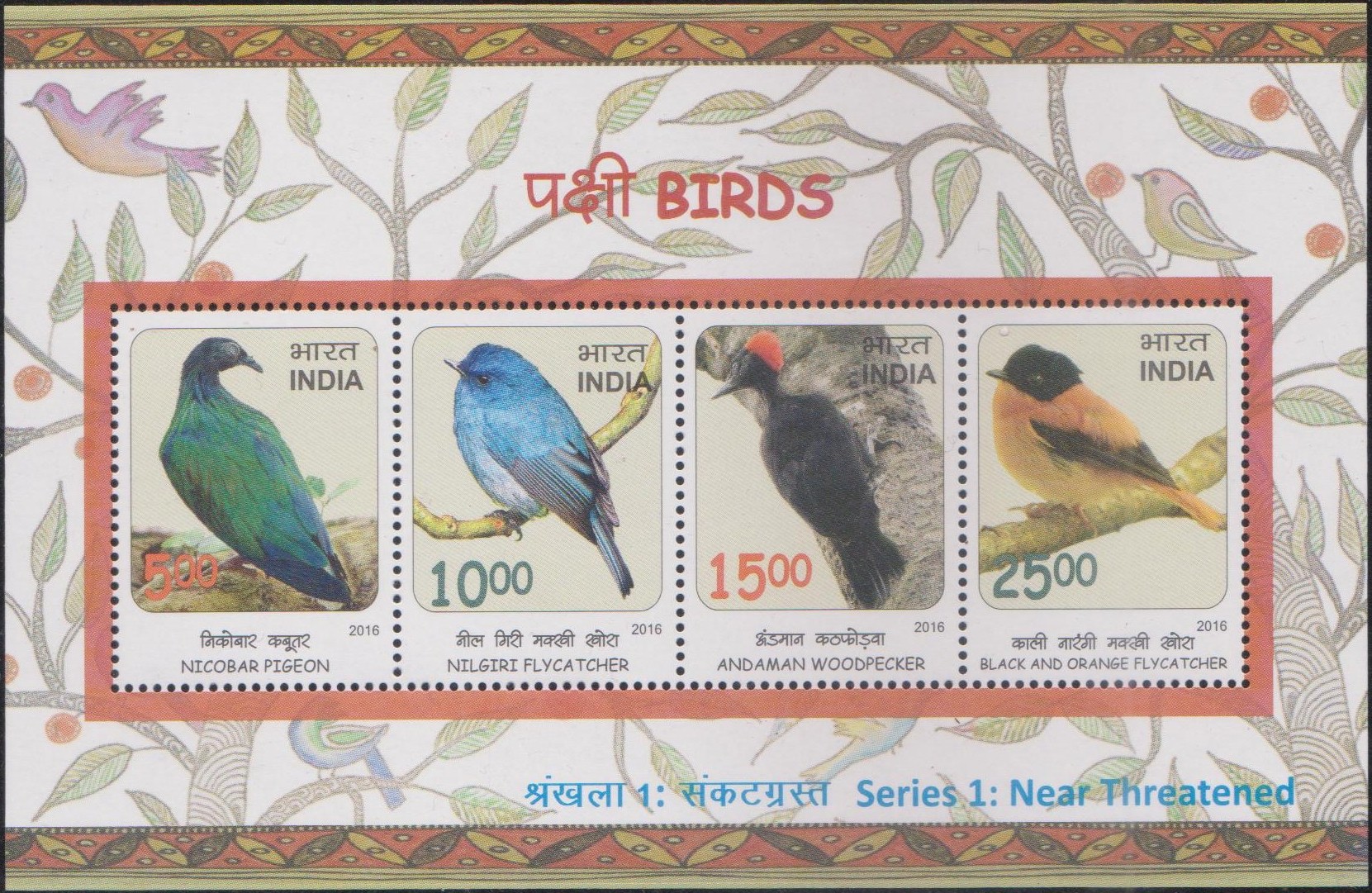
![1. Exotic Birds [India Stamps Miniature Sheet 2016]](https://istampgallery.com/wp-content/uploads/2017/03/1.-Exotic-Birds-India-Stamps-Miniature-Sheet-2016.jpg "Exotic Birds of India 2016")
![2275 Bandhavgarh National Park [India Stamp 2007]](https://istampgallery.com/wp-content/uploads/2015/10/2275-Bandhavgarh-National-Park-India-Stamp-2007.jpg "National Parks of India")
![1083 India 89 - International Stamp Exhibition [India Stamp 1987]](https://istampgallery.com/wp-content/uploads/2016/06/1083-India-89-International-Stamp-Exhibition-India-Stamp-1987.jpg "India-89")