

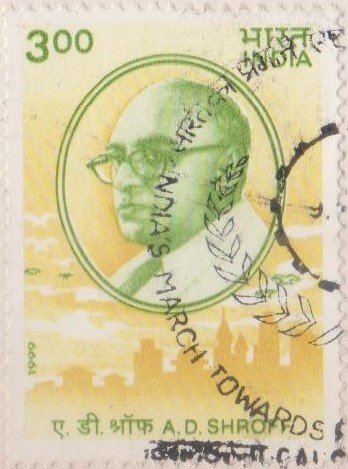
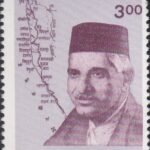
A commemorative postage stamp on A. D. Shroff (Darabshaw Shroff), a noted banker, economist and industrialist [a part of the series ‘India’s March towards Progress and Development‘] :

 Issued by India
Issued on Oct 9, 1999
Issued for : The Indian nationalist movement had asserted the right of the Indian people to shape their own destiny. The Constitution which came in force on 26th January 1950, was designed to be an instrument of India’s social and economic transformation. A nascent nation embarked on its march towards progress and socio-economic development. Leaders with foresight and a desire to improve the lot of the common people played crucial roles in different regions in the country’s achievements. The Department of Posts issues a set of four stamps in tribute to four visionaries of modern India, namely Dr. T.M.A. Pai, A.D. Shroff, A.B. Walawalkar and Chhaganlal K. Parekh, who have in their various ways contributed to India’s march towards progress and development.
Credits :
Stamp : ISP Nashik (based on material furnished by sponsors).
FDC : Sculpture at Sardar Patel Marg, New Delhi
Cancellation : Alka Sharma
Type : First Day Cover
Colour : Multi Colour
Denomination : 300 Paise
Overall size : 4.06 x 2.73 cms.
Printing size : 3.71 x 2.38 cms.
Perforation : 13 x 13
Paper : Imported unwatermarked Adhesive Gravure Coated Stamp Paper in Sheets 50.8 x 53.5 cms.
Stamps Printed : 1.4 Million
Number per issue sheet : 40
Printing Process : Photogravure
Printer : India Security Press, Nashik
Name : Ardeshir Darabshaw Shroff
Born on Jun 4, 1899 at Bombay, India
Died on Oct 27, 1965 at Bombay, India
About :
- A. D. Shroff (1899-1965) economist, industrialist and public spirited personality, deeply influenced India’s economic development. He completed his studies at the University of Bombay (Elphinstone College) and the London School of Economics. A non-official member of Indian delegation to Bretton Woods Conference at the end of World War-II. Shroff assisted in setting up the Industrial Credit and Investment Corporation of India (ICICI). He was one of the earliest to propagate planned economic development of the country. In 1944, along with seven other leading industrialists, he authored what is popularly known as the “Bombay Plan”. He also wrote extensively on economic subjects.
- Text : Based on material furnished by the sponsors.

![403 Jawaharlal Nehru & People [India Stamp 1964]](https://istampgallery.com/wp-content/uploads/2015/05/403-Jawaharlal-Nehru-People-India-Stamp-1964.jpg "India on Jawaharlal Nehru 1964")