


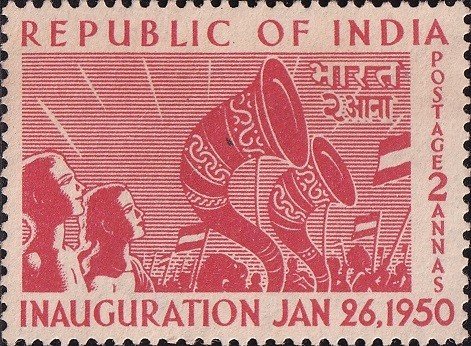
Complete Set of 4 nos of commemorative postage stamps on Inauguration of Indian Republic on 26 January, 1950 :
 Issued by India
Issued on Jan 26, 1950
Issued for : A new series of Postage stamps commemorating the inauguration of the Republic of India will be issued by the Indian Posts and Telegraphs Department on January 26, 1950. This comprises of a set of four stamps in denominations of 2 annas, 3.5 annas, 4 annas and 12 annas.
About :
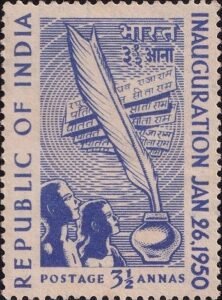
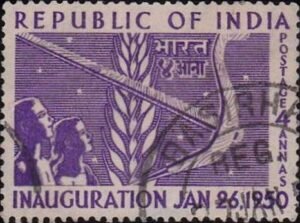
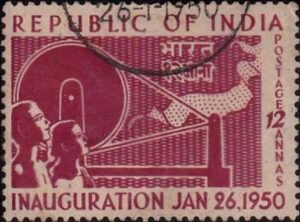
- The designs are simple and symbolic. The first in the series viz. 2 annas depicts a boy and a girl watching a procession of cavaliers carrying flags and blowing trumpets which herald India‘s attainment of full nationhood. The second in the series viz. 3.5 annas depicts a quill dipped into an inkpot with a number of leaflets in the background inscribed in Hindi with Mahatma Gandhi‘s favourite hymn ‘Raghupati Raghav Raja Ram‘ and in illustrative of India‘s nation building programme in the realm of Education. The third in the series viz. 4 annas, shows an ear of grain set vertically in the centre with an indigenous ploughshare placed diagonally behind a star-spangled background and is symbolic of India as an essentially agricultural country. The fourth and the last in the series is the 12 annas denomination. This depicts an indigenous handloom (Charkha), symbolic of India‘s Cottage Industry and of her progressive evolution with each round of the wheel. In the background is a piece of cloth which is hand spun and hand woven and which in its turn symbolises the importance of the ‘Charkha’ in India‘s rural economy.
- The words ‘Republic of India‘ and ‘Inauguration January 26, 1950‘ are inscribed along the sides of the stamps. On one of the sides appear the word ‘POSTAGE’ and the denominational value in English. In the top right hand corner of the inset is inscribed the word ‘BHARAT‘ and the value of the stamp in Hindi (Devnagri) script.
- The colours are Red, Blue, Violet and Maroon respectively.
- There are 13 perforations in each stamp.
- The stamps have been printed on watermark paper bearing a multiple of five pointed star all over.
- Except the 3.5 annas value, which is vertical in design, the remaining three values are horizontal, each measuring 1.14″ X 1.54″.
- The number of stamps in a full sheet of each denomination is 128.
- The 2 annas denomination is intended for inland postage, the 3.5 annas for foreign letter mail, the 4 annas for registration and 12 annas for foreign air mail.
- The stamps have been printed in limited quantities and will remain on sale concurrently with the corresponding denominations in the existing series until stocks are exhausted.
- The stamps are designed by Messrs. D. J. Keymer & Co. Ltd., Calcutta, and have been printed by the India Security Press, Nasik Road.
- Simultaneously with these commemoratives, a First Day Cover and a Folder will also be brought out. The designs for these have been obtained through the courtesy of the Commercial Arts Section of Sir J. J. School of Arts, Bombay.
- The price of the First Day Cover is 1 anna while that of the Folder is Rs. 1/9/6 inclusive of the values of stamps. The stamps in the folder are affixed by means of hinges. For persons buying First day Covers in bulk, the price has been fixed at Rs. 1/4/- for a packet of 25 envelopes or Rs. 5/- for a hundred.
- A special cancellation postmark has also been designed for use on the day of issue of these stamps, viz., January 26, 1950, but the use of this cachet has been restricted to the Philatelic Bureaux at Bombay, Calcutta, Madras, Simla, New Delhi, Lucknow, Patna, Cuttack, Shillong and Nagpur. The new cachet bears the name of the Post Office in Hindi script and the date viz., ’26-1-1950′ in international numerals.
- Orders for the purchase of these stamps, Folders and First day Covers may be placed with the Officer-in-Charge of any of the afore-mentioned Philatelic Bureaux at Bombay, Calcutta and Madras.
- Remittances to cover the cost of the stamps and stationary required must accompany the order and may be sent in cash under insured cover, by money order, crossed postal order, crossed cheque encashable in India or by means of Bank Draft payable in Indian currency. In all cases, orders should include full particulars of remittances made.
![2450 National Girl Child Day [India Stamp 2009]](https://istampgallery.com/wp-content/uploads/2016/03/2450-National-Girl-Child-Day-India-Stamp-2009-1.jpg "Indian National Girl Child Day 2009")
17 Comments
Ardeshir Darabshaw Shroff - iStampGallery
January 26, 1950[…] the right of the Indian people to shape their own destiny. The Constitution which came in force on 26th January 1950, was designed to be an instrument of India’s social and economic transformation. A nascent nation […]
A. B. Walawalkar - iStampGallery
January 26, 1950[…] the right of the Indian people to shape their own destiny. The Constitution which came in force on 26th January 1950, was designed to be an instrument of India’s social and economic transformation. A nascent nation […]
Rashtrapati Bhavan - iStampGallery
January 26, 1950[…] living heritage today stands majestically as a symbol of the world’s largest democracy, the Republic of […]
India on Mahatma Gandhi 2000 - iStampGallery
January 26, 1950[…] : The Department of Posts commemorates the Golden Jubilee of the Republic of India with issue of a special/commemorative stamp paying tribute to Father of the Nation, Mahatma Gandhi. […]
Havildar Abdul Hamid PVC - iStampGallery
January 26, 1950[…] Golden Jubilee of the Indian Republic provides the appropriate occasion to pay a grateful nation’s proud homage to the courageous […]
Captain Karam Singh PVC - iStampGallery
January 26, 1950[…] Golden Jubilee of the Indian Republic provides the appropriate occasion to pay a grateful nation’s proud homage to the courageous […]
Nirmal Jit Singh Sekhon - iStampGallery
January 26, 1950[…] Golden Jubilee of the Indian Republic provides the appropriate occasion to pay a grateful nation’s proud homage to the courageous […]
Natural Heritage of Manipur and Tripura - iStampGallery
January 26, 1950[…] by India. It holds a special place in international philately, as it commemorates 50 years of the Republic of India, and also the new millennium. It is being planned in a spectacular way with all the conveniences […]
Radha Govinda Baruah - iStampGallery
January 26, 1950[…] This year India celebrates 50 years of its Republic status. During the struggle for freedom, and in independent India leaders with rare insight and […]
Vijaya Lakshmi Pandit - iStampGallery
January 26, 1950[…] This year India celebrates 50 years of its Republic status. During the struggle for freedom, and in independent India leaders with rare insight and […]
Rettamalai Srinivasan - iStampGallery
January 26, 1950[…] This year India celebrates 50 years of its Republic status. During the struggle for freedom, and in independent India leaders with rare insight and […]
Jaglal Choudhary - iStampGallery
January 26, 1950[…] This year India celebrates 50 years of its Republic status. During the struggle for freedom, and in independent India leaders with rare insight and […]
Beautiful India 2017 - iStampGallery
January 26, 1950[…] of Posts is conducting stamp design competition on various themes from 2015 on the occasion of Republic Day, Independence Day and Children’s Day at national level. Based on the entries received from […]
Potter’s Wheel - iStampGallery
January 26, 1950[…] year on the occasion of Republic Day, Independence Day and Children’s Day, Department of Posts has been conducting stamp design […]
Indian Gems and Jewellery - iStampGallery
January 26, 1950[…] Asiana – 2000, XIV Asian International Exhibition, the Department’s tribute to 50 years of the Republic of India, and the New […]
Bharat – The Mother of Democracy - iStampGallery
January 26, 1950[…] 31 gun salute to the President heralded the birth of Indian Republic shortly before 1030 hours on January 26, 1950. It was 894 days after the country attained the […]
India-Egypt : Joint Issue - iStampGallery
January 26, 1950[…] on 18 August 1947. President of Egypt H.E. Mr Abdel Fattah EI Sisi is the Chief Guest on India’s Republic Day – 2023. India has also invited Egypt as ‘Guest Country’ during its G-20 Presidency this […]