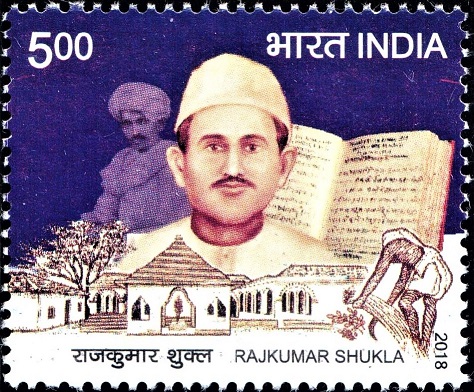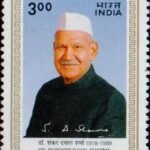


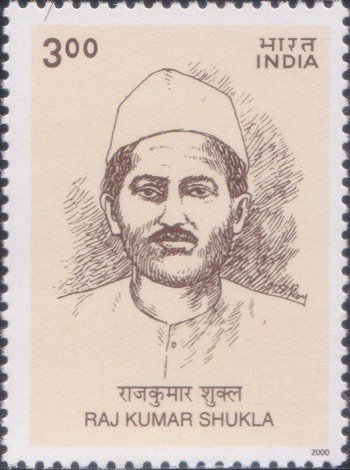
A commemorative postage stamp on the the 125th Birth Anniversary of Pandit Rajkumar Shukla, the farmer who persuaded Mahatma Gandhi to lead the Champaran Satyagraha against European indigo planters :
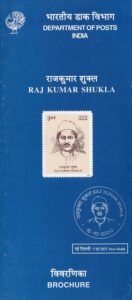 Issued by India
Issued on Oct 16, 2000
Issued for : This year marks the 125th Birth Anniversary of Raj Kumar Shukla. The Department of Posts is happy to issue this commemorative postage stamp to pay homage to his role in India’s struggle for Independence.
Credits :
Stamp & FDC : Based on book “Raj Kumar Shukla” by Rai Prabhakar Prasad & NCERT’s publication : India’s struggle for Independence.
Cancellation : Alka Sharma
Type : Stamp, Mint Condition
Colour : Two Colour
Denomination : 300 Paise
Overall size : 2.9 x 3.9 Cms.
Printing size : 2.6 x 3.55 Cms.
Perforation : 13.5 x 13.5
Paper : Matt Chromo
Stamps Printed : 0.1 Million
Number per issue sheet : 40
Printing Process : Photo Offset
Printer : Calcutta Security Printers Ltd.
Name : Raj Kumar Shukla
Born on 23 Aug, 1875 at Murli Bharahwa village, West Champaran district, Bihar, India
Died on 20 May, 1929 at Motihari, Bihar, India
About :
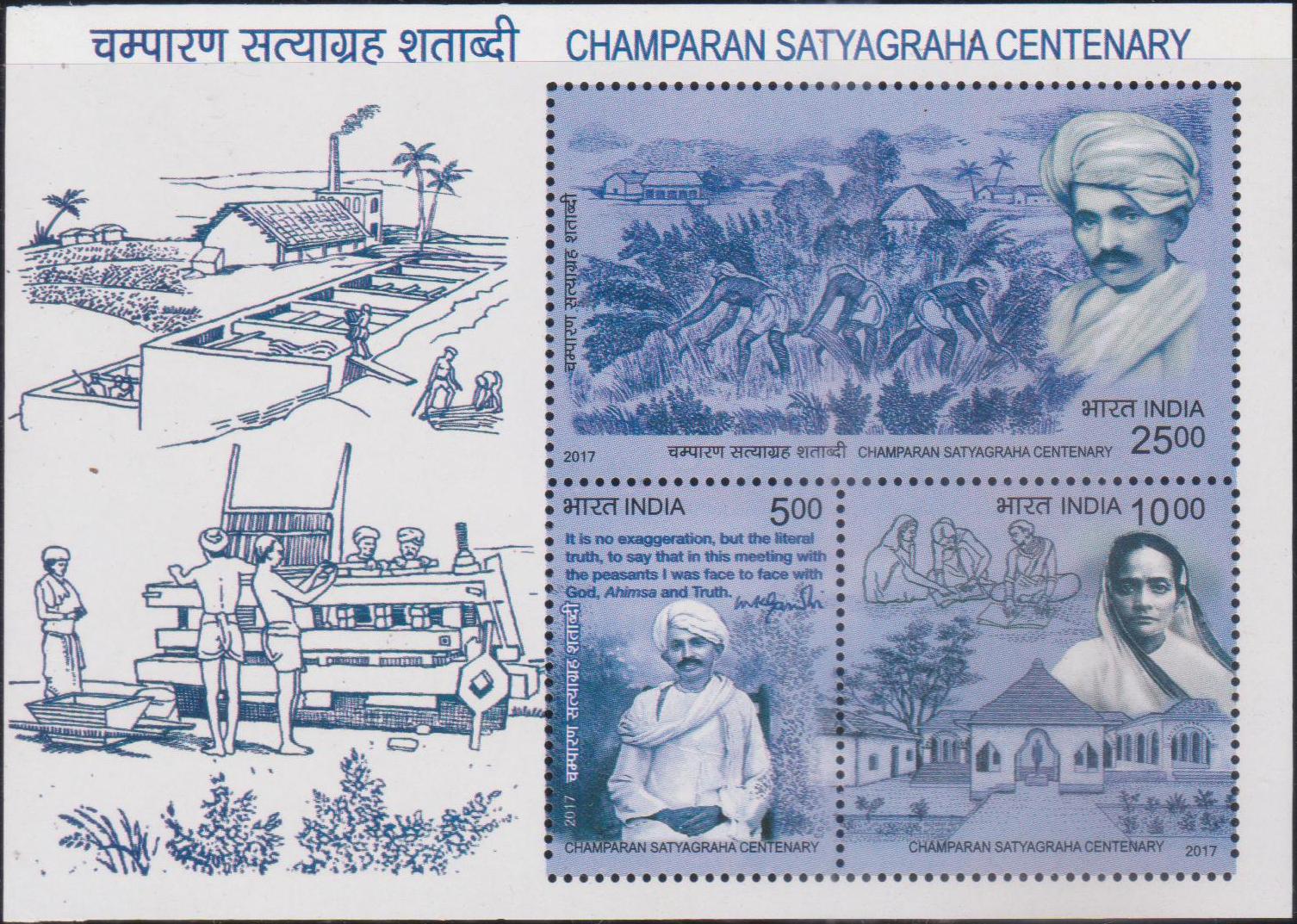
- In India’s struggle for Independence, the “Champaran Satyagraha” marks a very important stage. Raj Kumar Shukla drew the attention of Mahatma Gandhi, who had just returned from South Africa, to the plight of the peasants suffering under an oppressive system established by European indigo planters. Besides other excesses they were forced to cultivate indigo on 3/20 part of their holding and sell it to the planters at prices fixed by the planters. This marked Gandhiji’s entry into the India’s Struggle for Freedom. On his arrival at Motihari, the district headquarters, accompanied by Raj Kumar Shukla, Gandhiji was ordered to leave by the next available train which he refused to do and was arrested. He was released and the ban order was withdrawn in the face of a “Satyagraha” threat. Gandhiji conducted an open enquiry into the peasant’s grievances. The Government had to appoint an enquiry committee with Gandhiji as a member. This led to the abolition of the system.
- Raj Kumar Shukla has been described by Gandhiji in his “Atmakatha”, as a man whose suffering gave him the strength to rise against the odds. In his letter to Gandhiji he wrote –
- “Respected Mahatma, you hear the stories of others everyday. Today please listen to my story ……… I want to draw your attention to the promise made by you in the Lucknow Congress that you would come to Champaran. The time has come for you to fulfil your promise. 19 lakhs suffering people of Champaran are waiting to see you.”
- Gandhiji reached Patna on 10 April, 1917 and on 16 April he reached Motihari accompanied by Raj Kumar Shukla. Under Gandhiji’s leadership the historic “Champaran Satyagraha” began. The contribution of Raj Kumar Shukla is reflected in the writings of Dr. Rajendra Prasad, first President of India, Acharya Kriplani and of course Mahatma Gandhi himself. Raj Kumar Shukla maintained a diary in which he was given an account of struggle against the atrocities of the indigo planters, atrocities so movingly depicted by Deen Bandhu Mitra in “Neel Darpan”, a play that was translated by Michael Madhusudan Dutt.
- Text : Based on book “Raj Kumar Shukla” by Rai Prabhakar Prasad & NCERT’s publication : India’s struggle for Independence.